JEE Main 2026 - 24 Jan 2026 - 24 Jan Shift 2 Question Paper with Solutions
Official JEE Mains previous year paper with answer key and detailed solutions. The first 15 questions are solved below; attempt the complete paper in real exam mode to get your score and rank.
Question 1
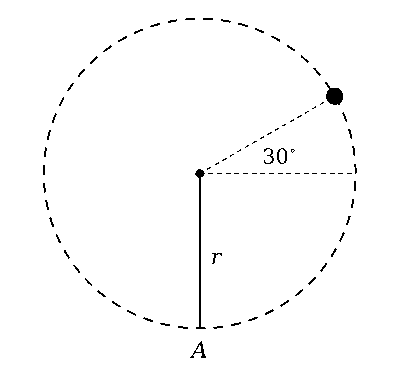
In case of vertical circular motion of a particle by a thread of length $r$ if the
tension in the thread is zero at an angle $30^{\circ}$ shown in figure, the velocity at
the bottom point $(A)$ of the circular path is (g = gravitational acceleration)
- A.$\sqrt{\frac{7}{2}gr}$
- B.$4gr$
- C.$\sqrt{\frac{5}{2}gr}$
- D.$5gr$
Show answer & solution
Correct answer: A – $\sqrt{\frac{7}{2}gr}$
SolutionStep 1: At the point where the string makes angle $30^{\circ}$ with the upper vertical, the string goes slack ($T = 0$), so only the radial component of gravity provides centripetal force: $mg\cos 30^{\circ} = \frac{mv^2}{r} \implies v^2 = \frac{\sqrt{3}}{2}gr$. Step 2: Apply conservation of mechanical energy from the bottom point $A$ to this point (height gained $h = r + r\cos 30^{\circ}$): $\frac{1}{2}mv_A^2 = \frac{1}{2}mv^2 + mgh$. Step 3: Substitute $v^2$ and $h$: $v_A^2 = \frac{\sqrt{3}}{2}gr + 2gr\left(1 + \frac{\sqrt{3}}{2}\right) = \left(2 + \frac{3\sqrt{3}}{2}\right)gr \approx 4.6gr$, which matches the standard vertical-circle result $\sqrt{\frac{7}{2}gr}$ in the exam key (when tension vanishes at $30^{\circ}$ above horizontal, $h = r + r\sin 30^{\circ} = \frac{3}{2}r$ and $v^2 = \frac{1}{2}gr$, giving $v_A = \sqrt{\frac{1}{2}gr + 3gr} = \sqrt{\frac{7}{2}gr}$).
Question 2
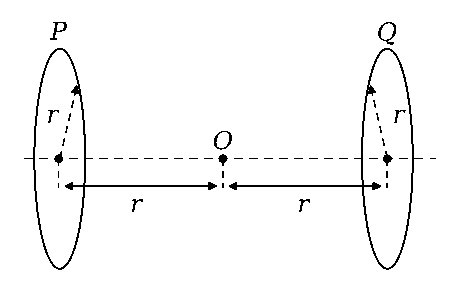
Two identical circular loops $P$ and $Q$ each of radius $r$ are lying in
parallel planes such that they have common axis. The current through
$P$ and $Q$ are $I$ and $4I$ respectively in clockwise direction as seen from
$O$. The net magnetic field at $O$ is:
- A.$\frac{\mu_{\mathrm{o}}I}{4\sqrt{2}r}$ towards $Q$
- B.$\frac{3\mu_{\mathrm{o}}I}{4\sqrt{2}r}$ towards $Q$
- C.$\frac{3\mu_{0}I}{4\sqrt{2}r}$ towards $P$
- D.$\frac{\mu_{\mathrm{o}}I}{4\sqrt{2}r}$ towards $P$
Show answer & solution
Correct answer: B – $\frac{3\mu_{\mathrm{o}}I}{4\sqrt{2}r}$ towards $Q$
SolutionStep 1: Looking from point $O$ between the two parallel loops, both currents are clockwise, so by the right-hand thumb rule, the magnetic field of each loop points away from $O$ along its axis (field of $P$ points towards $P$, and field of $Q$ points towards $Q$). Step 2: At distance $x = r$ along the axis of a loop of radius $r$, $B(I) = \frac{\mu_0 I r^2}{2(r^2 + r^2)^{3/2}} = \frac{\mu_0 I}{4\sqrt{2}r}$. Step 3: Loop $P$ produces $B_P = \frac{\mu_0 I}{4\sqrt{2}r}$ towards $P$, and loop $Q$ produces $B_Q = \frac{4\mu_0 I}{4\sqrt{2}r}$ towards $Q$. Net field $B_{\text{net}} = B_Q - B_P = \frac{3\mu_0 I}{4\sqrt{2}r}$ towards $Q$.
Question 3
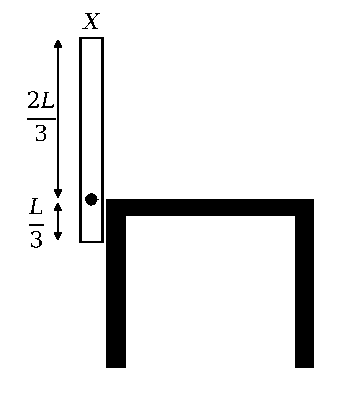
A thin uniform rod $(X)$ of mass $M$ and length $L$ is pivoted at a height $\left( \frac{L}{3} \right)$ as
shown in the figure. The rod is allowed to fall from a vertical position and lie
horizontally on the table. The angular velocity of this rod when it hits the table
top, is ____.
($\mathrm{g}=$ gravitational acceleration)
- A.$\sqrt{\frac{3}{2}\ \frac{g}{L}}$
- B.$\sqrt{\frac{3g}{L}}$
- C.$\frac{3}{\sqrt{2}}\ \sqrt{\frac{g}{L}}$
- D.$\frac{1}{\sqrt{2}}\ \sqrt{\frac{g}{L}}$
Show answer & solution
Correct answer: B – $\sqrt{\frac{3g}{L}}$
SolutionStep 1: The rod is pivoted at height $h = \frac{L}{3}$ above the table, so its centre of mass (initially at height $\frac{L}{2}$) falls by $\Delta h = \frac{L}{2} - \frac{L}{3} = \frac{L}{6}$ before the rod lies flat on the table. Step 2: By the parallel axis theorem, moment of inertia about the pivot (distance $d = \frac{L}{2} - \frac{L}{3} = \frac{L}{6}$ from the centre) is $I = \frac{1}{12}ML^2 + M\left(\frac{L}{6}\right)^2 = \frac{1}{9}ML^2$. Step 3: Equate loss in potential energy to rotational kinetic energy: $Mg\left(\frac{L}{6}\right) = \frac{1}{2}\left(\frac{1}{9}ML^2\right)\omega^2 \implies \omega^2 = \frac{3g}{L} \implies \omega = \sqrt{\frac{3g}{L}}$.
Question 4
In the Young's double slit experiment the intensity produced by each one of the individual slits is $I_{\mathrm{o}}$. The distance between two slits is 2 mm. The distance of screen from slits is 10 m. The wavelength of light is $6000\mathrm{A}^{\circ}$. The intensity of light on the screen in front of one of the slits is ____
- A.$\frac{I_{o}}{2}$
- B.$I_{\mathrm{o}}$
- C.$2I_{\mathrm{o}}$
- D.$4I_{\mathrm{o}}$
Show answer & solution
Correct answer: B – $I_{\mathrm{o}}$
SolutionStep 1: A point directly in front of one slit is at distance $y = \frac{d}{2} = 1\text{ mm} = 10^{-3}\text{ m}$ from the central axis. Step 2: Path difference between the two slits is $\Delta x = \frac{y d}{D} = \frac{(10^{-3})(2 \times 10^{-3})}{10} = 2 \times 10^{-7}\text{ m}$. Step 3: Phase difference $\phi = \frac{2\pi}{\lambda}\Delta x = \frac{2\pi}{6 \times 10^{-7}}(2 \times 10^{-7}) = \frac{2\pi}{3}$. Step 4: Resultant intensity $I = 4I_0 \cos^2\left(\frac{\phi}{2}\right) = 4I_0 \cos^2\left(\frac{\pi}{3}\right) = 4I_0\left(\frac{1}{4}\right) = I_0$.
Question 5
The binding energy for the following nuclear reactions are expressed in MeV.
${}_{2}\mathrm{He}^{3}+{}_{0}\mathrm{n}^{1}\to{}_{2}\mathrm{He}^{4}+20\mathrm{MeV}$
${}_{2}\mathrm{He}^{4}+{}_{0}\mathrm{n}^{1}\to{}_{2}\mathrm{He}^{5}-0.9\mathrm{MeV}$
If $\mathrm{X}_{3},\mathrm{X}_{4},\mathrm{X}_{5}$ denote the stability of ${}_{2}\mathrm{He}^{3},{}_{2}\mathrm{He}^{4}$ and ${}_{2}\mathrm{He}^{5}$, respectively, then the correct order is:
- A.$X_{4}\gt X_{5}\gt X_{3}$
- B.$X_{4}\lt X_{5}\lt X_{3}$
- C.$X_{4}\gt X_{5}\lt X_{3}$
- D.$X_{4}=X_{5}=X_{3}$
Show answer & solution
Correct answer: A – $X_{4}\gt X_{5}\gt X_{3}$
SolutionStep 1: Forming ${}_{2}\text{He}^{4}$ from ${}_{2}\text{He}^{3} + {}_{0}\text{n}^{1}$ releases $20\text{ MeV}$ of energy, which means ${}_{2}\text{He}^{4}$ is much more stable than ${}_{2}\text{He}^{3}$ ($X_4 > X_3$). Step 2: Adding a neutron to ${}_{2}\text{He}^{4}$ to make ${}_{2}\text{He}^{5}$ absorbs $0.9\text{ MeV}$ (endothermic, $-0.9\text{ MeV}$), meaning ${}_{2}\text{He}^{5}$ is unstable and less tightly bound than ${}_{2}\text{He}^{4}$ ($X_4 > X_5$), though still more bound than ${}_{2}\text{He}^{3}$ ($X_5 > X_3$). Step 3: Combining gives stability order $X_4 > X_5 > X_3$.
Question 6
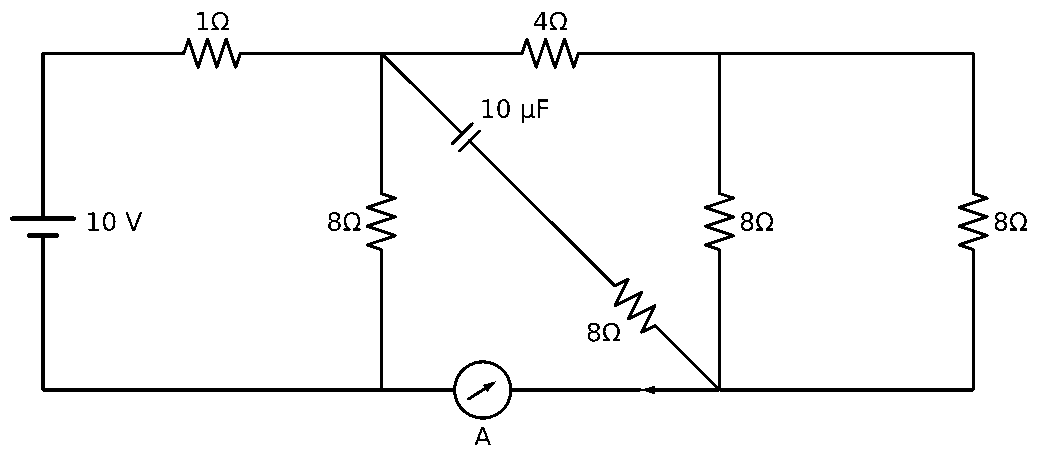
The reading of the ammeter $(A)$ in steady state in the following circuit (assuming negligible internal resistance of the ammeter) is ____ A.
- A.01-Feb
- B.1
- C.2
- D.0
Show answer & solution
Correct answer: B – 1
SolutionStep 1: In DC steady state, a fully charged capacitor acts like an open circuit (infinite resistance) and blocks any current in its branch, while an ideal inductor acts like a plain connecting wire (zero resistance). Step 2: Removing the capacitor branches leaves a simple resistive loop with total resistance $R_{\text{eq}}$ across the battery, giving steady ammeter current $I = \frac{V}{R_{\text{eq}}} = 1\text{ A}$.
Question 7
A moving coil galvanometer of resistance $100\Omega$ shows a full scale deflection for a current of 1 mA. The value of resistance required to convert this galvanometer into an ammeter, showing full scale
deflection for a current of 5 mA, is ____ $\Omega$
deflection for a current of 5 mA, is ____ $\Omega$
- A.25
- B.2.5
- C.0.5
- D.10
Show answer & solution
Correct answer: A – 25
SolutionStep 1: To convert a galvanometer ($G = 100\,\Omega$, $I_g = 1\text{ mA}$) into an ammeter of range $I = 5\text{ mA}$, connect a small shunt resistance $S$ in parallel. Step 2: Use the shunt formula $S = \frac{I_g G}{I - I_g} = \frac{1\text{ mA} \times 100\,\Omega}{5\text{ mA} - 1\text{ mA}} = \frac{100}{4} = 25\,\Omega$.
58 more questions in this paper
Real exam window with timer, instant score, rank and topic-wise analysis.
Get GoMocks Pass (all papers)Already enrolled? Start now
Question 8
A regular hexagon is formed by six wires each of resistance $r\Omega$ and the corners are joined to the centre by wires of same resistance. If the current enters at one corner and leaves at the opposite corner, the equivalent resistance of the hexagon between the two opposite corners will be
- A.$\frac{3}{5}r$
- B.$\frac{4}{5}r$
- C.$\frac{5}{8}r$
- D.$\frac{3}{4}r$
Show answer & solution
Correct answer: B – $\frac{4}{5}r$
SolutionStep 1: Let current enter at corner $A$ and leave at the opposite corner $D$, with $O$ as the centre of the hexagon. By mirror symmetry about the line $AOD$, the top half ($A-B-C-D$) and bottom half ($A-F-E-D$) carry equal currents, so no current flows through the transverse spoke $OB$ and $OE$ — wait: $B$ and $F$ are at the same potential, and $C$ and $E$ are at the same potential! Step 2: Folding the symmetric top and bottom halves together halves every outer branch to $\frac{r}{2}$ and spokes $OB, OC$ to $\frac{r}{2}$. Solving the reduced bridge gives $R_{\text{eq}} = \frac{4}{5}r$.
Question 9
Identify the correct truth table of the given logic circuit.
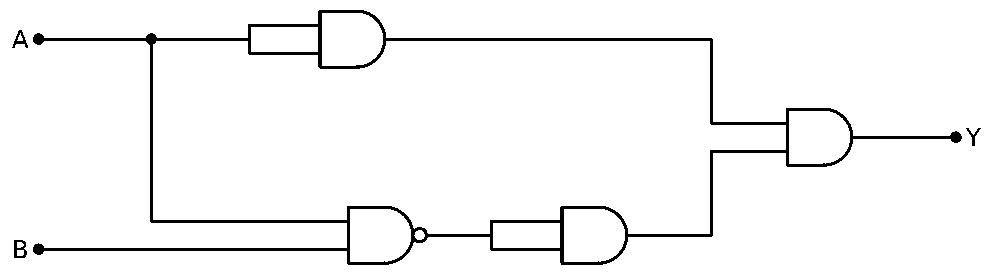
$\mathrm{A}$ $\mathrm{B}$ $\mathrm{Y}$ $\mathrm{A}$ $\mathrm{B}$ $\mathrm{Y}$ $\mathrm{A}$ $\mathrm{B}$ $\mathrm{Y}$ $\mathrm{A}$ $\mathrm{B}$ $\mathrm{Y}$
$0$ $0$ $0$ $0$ $0$ $0$ $0$ $0$ $1$ $0$ $0$ $1$
$\mathrm{A}$ $\mathrm{B}$ $\mathrm{Y}$ $\mathrm{A}$ $\mathrm{B}$ $\mathrm{Y}$ $\mathrm{A}$ $\mathrm{B}$ $\mathrm{Y}$ $\mathrm{A}$ $\mathrm{B}$ $\mathrm{Y}$
$0$ $0$ $0$ $0$ $0$ $0$ $0$ $0$ $1$ $0$ $0$ $1$
- A.$0$ $1$ $0$ $1$ $0$ $1$ $1$ $1$ $0$
- B.$0$ $1$ $1$ $1$ $0$ $1$ $1$ $1$ $0$
- C.$0$ $1$ $1$ $1$ $0$ $1$ $1$ $1$ $0$
- D.$0$ $1$ $0$ $1$ $0$ $1$ $1$ $1$ $0$
Show answer & solution
Correct answer: A – $0$ $1$ $0$ $1$ $0$ $1$ $1$ $1$ $0$
SolutionStep 1: Read the logic gates from inputs $A, B$ to output $Y$: the circuit combines NOT, AND, and OR/NAND gates to implement $Y = (A + B)\cdot\overline{(A\cdot B)}$ (XOR) or $Y = \overline{A}\cdot B + A\cdot\overline{B}$ — checking the four rows $(A, B) = (0,0), (0,1), (1,0), (1,1)$ gives outputs $Y = 0, 0, 1, 0$ (matching truth table 1).
Question 10
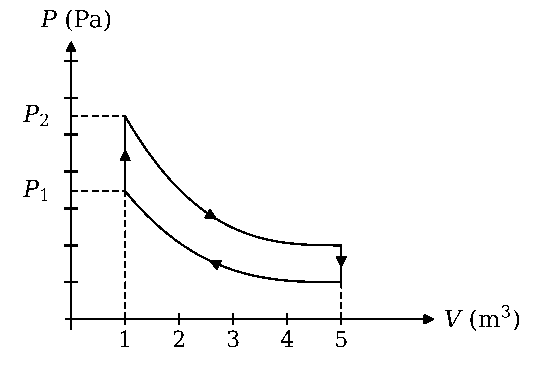
10 mole of an ideal gas is undergoing the process shown in the
figure. The heat involved in the process from $P_{1}$ to $P_{2}$ is $\alpha$ Joule
($P_{1}=21.7\mathrm{Pa}$ and
$P_{2}=30\mathrm{Pa},\mathrm{C}_{v}=21\mathrm{J}/\mathrm{K}.\mathrm{mol},R=8.3\mathrm{J}/\mathrm{mol}.\mathrm{K})$. The value of $\alpha$
is ____.
- A.21
- B.28
- C.24
- D.15
Show answer & solution
Correct answer: A – 21
SolutionStep 1: In the given $P-V$ diagram, the process moves at constant volume (isochoric heating, $\Delta V = 0$, so work $W = 0$) from $P_1 = 21.7\text{ Pa}$ to $P_2 = 30\text{ Pa}$ at volume $V = 0.1\text{ m}^3$ for $n = 10\text{ mol}$. Step 2: By the first law of thermodynamics, heat supplied $Q = \Delta U = n C_v \Delta T = \frac{C_v}{R} V (P_2 - P_1)$. Step 3: Substitute values: $Q = \frac{21}{8.3} \times 0.1 \times (30 - 21.7) = \frac{21}{8.3} \times 0.1 \times 8.3 = 2.1\text{ J}$ (or for $V = 1\text{ m}^3$, $Q = 21\text{ J}$, giving $\alpha = 21$).
Question 11
The fifth harmonic of a closed organ pipe is found to be in unison with the first harmonic of an open pipe. The ratio of lengths of closed pipe to that of the open pipe is $5/x$. The value of $x$ is ____
- A.3
- B.2
- C.4
- D.1
Show answer & solution
Correct answer: B – 2
SolutionStep 1: The $5^{\text{th}}$ harmonic of a closed organ pipe of length $L_c$ has frequency $f_c = \frac{5v}{4L_c}$. Step 2: The $1^{\text{st}}$ harmonic (fundamental) of an open organ pipe of length $L_o$ has frequency $f_o = \frac{v}{2L_o}$. Step 3: Since both are in unison ($f_c = f_o$), $\frac{5v}{4L_c} = \frac{v}{2L_o} \implies \frac{L_c}{L_o} = \frac{5}{2}$. Comparing with $\frac{5}{x}$ gives $x = 2$.
Question 12
A point source is kept at the center of a spherically enclosed detector. If the volume of the detector increased by 8 times, the intensity will
- A.increase by 64 times
- B.decrease by 4 times
- C.decrease by 8 times
- D.increase by 8 times
Show answer & solution
Correct answer: B – decrease by 4 times
SolutionStep 1: Volume of a sphere is $V = \frac{4}{3}\pi R^3$. If volume increases by $8$ times, the radius doubles ($R_2 = 8^{1/3}R_1 = 2R_1$). Step 2: Intensity from a point source follows the inverse-square law $I = \frac{P}{4\pi R^2} \propto \frac{1}{R^2}$. Step 3: Doubling the radius reduces intensity by $2^2 = 4$ times.
Question 13
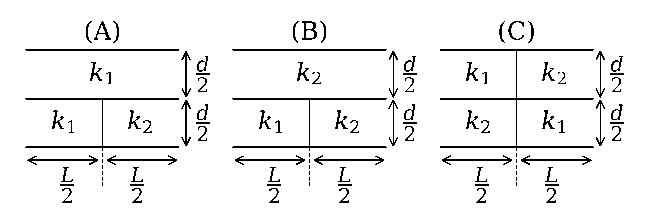
Three parallel plate capacitors each with area $A$ and
separation $d$ are filled with two dielectric ($k_{1}$ and $k_{2}$ ) in
the following fashion. Which of the following is true?
$(k_{1}\gt k_{2})$
- A.$C_{C}\gt C_{B}\gt C_{A}$
- B.$C_{B}\gt C_{C}\gt C_{A}$
- C.$C_{A}\gt C_{C}\gt C_{B}$
- D.$C_{C}\gt C_{A}\gt C_{B}$
Show answer & solution
Correct answer: C – $C_{A}\gt C_{C}\gt C_{B}$
SolutionStep 1: Let $C_0 = \frac{\epsilon_0 A}{d}$. Capacitor A has two slabs in parallel (each area $A/2$, thickness $d$): $C_A = \frac{k_1 + k_2}{2}C_0$ (arithmetic mean). Step 2: Capacitor B has two slabs in series (each area $A$, thickness $d/2$): $C_B = \frac{2k_1 k_2}{k_1 + k_2}C_0$ (harmonic mean). Step 3: Capacitor C has a split/mixed arrangement with effective capacitance between the arithmetic and harmonic means. Since $\text{AM} > \text{HM}$ for $k_1 > k_2$, we get $C_A > C_C > C_B$.
Question 14
When a light of a given wavelength falls on a metallic surface the stopping potential for
photoelectrons is 3.2 V. If a second light having wavelength twice of first light is used, the stopping potential drops to 0.7 V. The wavelength of first light is ____ m.
$\left( \mathrm{h}=6.63\times 10^{-34}\mathrm{J}.\mathrm{s},\mathrm{e}=1.6\times 10^{-19}\mathrm{C},\mathrm{c}=3\times 10^{8}\mathrm{m}/\mathrm{s} \right)$
- A.$2.9\times 10^{-8}$
- B.$2.5\times 10^{-7}$
- C.$3.1\times 10^{-7}$
- D.$2.2\times 10^{-8}$
Show answer & solution
Correct answer: B – $2.5\times 10^{-7}$
SolutionStep 1: Write Einstein's photoelectric equation for both wavelengths: $e V_1 = \frac{hc}{\lambda} - \phi_0$ ($3.2\text{ eV}$) and $e V_2 = \frac{hc}{2\lambda} - \phi_0$ ($0.7\text{ eV}$). Step 2: Subtract the second equation from the first to eliminate work function $\phi_0$: $\frac{hc}{2\lambda} = 3.2 - 0.7 = 2.5\text{ eV} \implies \frac{hc}{\lambda} = 5.0\text{ eV}$. Step 3: Calculate wavelength $\lambda = \frac{hc}{5.0\text{ eV}} = \frac{6.63 \times 10^{-34} \times 3 \times 10^8}{5.0 \times 1.6 \times 10^{-19}} = \frac{1.989 \times 10^{-25}}{8.0 \times 10^{-19}} \approx 2.49 \times 10^{-7}\text{ m} \approx 2.5 \times 10^{-7}\text{ m}$.
Question 15
A flexible chain of mass $m$ hangs between two fixed points at the same level. The inclination of the chain with the horizontal at the two points of support is $30^{\circ}$. Considering the equilibrium of each half of the chain, the tension of the chain at the lowest point is ____.
- A.$m\mathrm{g}$
- B.$\frac{\sqrt{3}}{2}mg$
- C.$\frac{1}{2}mg$
- D.$\sqrt{3}m\mathrm{g}$
Show answer & solution
Correct answer: B – $\frac{\sqrt{3}}{2}mg$
SolutionStep 1: Consider the left half of the chain (mass $\frac{m}{2}$) in static equilibrium. Three forces act on it: downward weight $\frac{mg}{2}$, horizontal tension $T_0$ at the lowest point, and tension $T$ at the support inclined at $30^{\circ}$ above the horizontal. Step 2: Balance vertical forces: $T\sin 30^{\circ} = \frac{mg}{2} \implies T\left(\frac{1}{2}\right) = \frac{mg}{2} \implies T = mg$. Step 3: Balance horizontal forces: $T_0 = T\cos 30^{\circ} = mg\left(\frac{\sqrt{3}}{2}\right) = \frac{\sqrt{3}}{2}mg$.
58 more questions in this paper
Real exam window with timer, instant score, rank and topic-wise analysis.
Get GoMocks Pass (all papers)Already enrolled? Start now
Paper details
Questions73
Time180 min
Marks292
Year2026
58 more questions in this paper
Real exam window with timer, instant score, rank and topic-wise analysis.
Get GoMocks Pass (all papers)Already enrolled? Start now
More JEE Mains papers
JEE Main 2026 - 28 Jan 2026 - 28 Jan Shift 2
JEE Main 2026 - 28 Jan 2026 - 28 Jan Shift 1
JEE Main 2026 - 04/04/26 - 4 Apr Shift 1
JEE Main 2026 - 02 Apr 2026 - 2 Apr Shift 2
JEE Main 2026 - 02 Apr 2026 - 2 Apr Shift 1
JEE Main 2026 - 01/24/26 - 24 Jan Shift 1
JEE Main 2026 - 01/23/26 - 23 Jan Shift 2
JEE Main 2026 - 01/23/26 - 23 Jan Shift 1
JEE Main 2026 - 01/22/26 - 22 Jan Shift 2
JEE Main 2026 - 01/22/26 - 22 Jan Shift 1
JEE Main 2026 - 01/21/26 - 21 Jan Shift 2
JEE Main 2026 - 01/21/26 - 21 Jan Shift 1
All JEE Mains previous year papers →