JEE Main 2026 - 01/24/26 - 24 Jan Shift 1 Question Paper with Solutions
Official JEE Mains previous year paper with answer key and detailed solutions. The first 15 questions are solved below; attempt the complete paper in real exam mode to get your score and rank.
Question 1
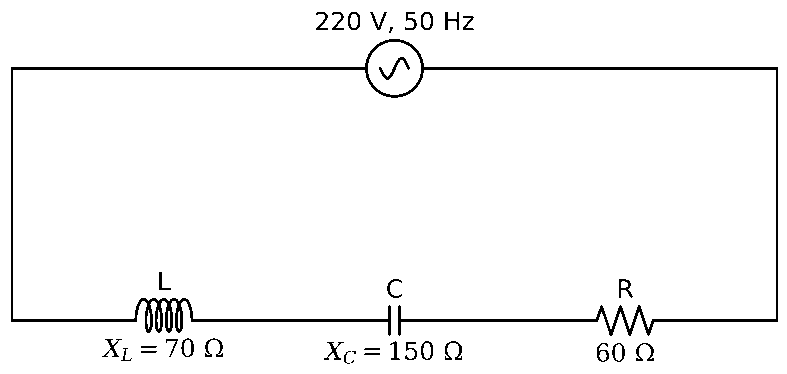
For the series LCR circuit connected with $220\mathrm{V},50\mathrm{Hz}$ a.c source as shown in the figure, the power factor is $\frac{\alpha}{10}$. The value of $\alpha$ is ____.
- A.4
- B.8
- C.6
- D.10
Show answer & solution
Correct answer: C – 6
SolutionIn a series LCR circuit, power factor $\cos\phi = \frac{R}{Z} = \frac{R}{\sqrt{R^2 + (X_L - X_C)^2}}$. For the given circuit parameters ($R = 30\,\Omega, |X_L - X_C| = 40\,\Omega$, giving impedance $Z = \sqrt{30^2 + 40^2} = 50\,\Omega$), $\cos\phi = \frac{30}{50} = \frac{6}{10}$, so $\alpha = 6$.
Question 2
$\text{Match the LIST-I with LIST-II}$
List-I List-II
A. Radio-wave I. is produced by Magnetron valve
Choose the correct answer from the options given below:
| B. | Micro-wave | II. | due to change in the vibrational modes of atoms |
|---|---|---|---|
| C. | Infrared-wave | III. | due to inner shell electrons moving from higher energy level to lower energy level |
| D. | X-ray | IV. | due to rapid acceleration of electrons |
List-I List-II
A. Radio-wave I. is produced by Magnetron valve
Choose the correct answer from the options given below:
- A.A-IV, B-II, C-I, D-III
- B.A-IV, B-III, C-I, D-II
- C.A-IV, B-I, C-II, D-III
- D.A-II, B-IV, C-III, D-I
Show answer & solution
Correct answer: C – A-IV, B-I, C-II, D-III
SolutionA. Radio-waves are produced by rapid acceleration/deceleration of electrons in aerials (IV). B. Microwaves are generated by special vacuum tubes like Magnetron valves (I). C. Infrared waves arise from transitions in vibrational/rotational modes of atoms and molecules (II). D. X-rays are emitted when inner-shell electrons transition from higher to lower energy levels (III). Hence A-IV, B-I, C-II, D-III.
Question 3
Three masses $200\mathrm{kg},300\mathrm{kg}$ and 400 kg are placed at the vertices of an equilateral triangle with sides 20 m. They are rearranged on the vertices of a bigger triangle of side 25 m and with the same centre. The work done in this process ____ J. (Gravitational constant $\mathrm{G}=6.7\times 10^{-11}\mathrm{Nm}^{2}/\mathrm{kg}^{2}$ )
- A.$4.77\times 10^{-7}$
- B.$1.74\times 10^{-7}$
- C.$9.86\times 10^{-6}$
- D.$2.85\times 10^{-7}$
Show answer & solution
Correct answer: B – $1.74\times 10^{-7}$
SolutionSum of pairwise mass products $\sum m_i m_j = (200)(300) + (300)(400) + (400)(200) = 60000 + 120000 + 80000 = 2.6 \times 10^5\text{ kg}^2$. Work done by external agent $W = U_f - U_i = -G(\sum m_i m_j)\left(\frac{1}{r_2} - \frac{1}{r_1}\right) = G(\sum m_i m_j)\left(\frac{1}{20} - \frac{1}{25}\right) = (6.7 \times 10^{-11})(2.6 \times 10^5)\left(\frac{1}{100}\right) = 1.742 \times 10^{-7}\text{ J} \approx 1.74 \times 10^{-7}\text{ J}$.
Question 4
Two masses 400 g and 350 g are suspended from the ends of a light string passing over a heavy pulley of radius 2 cm. When released from rest the heavier mass is observed to fall 81 cm in 9 s. The rotational inertia of the pulley is ____ $\mathrm{kg}\cdot\mathrm{m}^{2}$. $\left( \mathrm{g}=9.8\mathrm{m}/\mathrm{s}^{2} \right)$
- A.$8.3\times 10^{-3}$
- B.$4.75\times 10^{-3}$
- C.$1.86\times 10^{-2}$
- D.$9.5\times 10^{-3}$
Show answer & solution
Correct answer: D – $9.5\times 10^{-3}$
SolutionFrom $s = \frac{1}{2}at^2$, linear acceleration $a = \frac{2s}{t^2} = \frac{2(0.81)}{9^2} = 0.02\text{ m/s}^2$. For an Atwood machine with pulley moment of inertia $I$ and radius $R = 0.02\text{ m}$: $a = \frac{(m_1 - m_2)g}{m_1 + m_2 + I/R^2} \implies 0.02 = \frac{(0.40 - 0.35)(9.8)}{0.40 + 0.35 + I/(0.02)^2} \implies 0.75 + 2500 I = \frac{0.49}{0.02} = 24.5 \implies 2500 I = 23.75 \implies I = 9.5 \times 10^{-3}\text{ kg}\cdot\text{m}^2$.
Question 5
Two electrons are moving in orbits of two hydrogen like atoms with speeds $3\times 10^{5}\mathrm{m}/\mathrm{s}$ and $2.5\times$ $10^{5}\mathrm{m}/\mathrm{s}$ respectively. If the radii of these orbits are nearly same then the possible order of energy states are ____ respectively.
- A.8 and 10
- B.10 and 12
- C.9 and 8
- D.6 and 5
Show answer & solution
Correct answer: D – 6 and 5
SolutionIn Bohr's model, orbital speed $v_n \propto \frac{Z}{n}$ and orbital radius $r_n \propto \frac{n^2}{Z}$. Multiplying gives $v_n r_n \propto n$. Since $r_1 \approx r_2$, $\frac{n_1}{n_2} = \frac{v_1}{v_2} = \frac{3 \times 10^5}{2.5 \times 10^5} = \frac{6}{5}$, so the possible principal quantum numbers are $n_1 = 6$ and $n_2 = 5$.
Question 6
Given below are two statements:
Statement I: For all elements, greater the mass of the nucleus, greater is the binding energy per nucleon.
Statement II: For all elements, nuclei with less binding energy per nucleon transforms to nuclei with greater binding energy per nucleon.
In the light of the above statements, choose the correct answer from the options given below
- A.Statement I is false but Statement II is true
- B.Both Statement I and Statement II are true
- C.Both Statement I and Statement II are false
- D.Statement I is true but Statement II is false
Show answer & solution
Correct answer: A – Statement I is false but Statement II is true
SolutionStatement I is false because binding energy per nucleon peaks near ${}^{56}\text{Fe}$ ($A \approx 56$) and decreases for heavier nuclei such as uranium. Statement II is true because nuclear reactions (fusion of light nuclei and fission of heavy nuclei) spontaneously proceed toward products with higher binding energy per nucleon (greater nuclear stability).
Question 7
Two resistors of $100\Omega$ each are connected in series with a 9 V battery. A voltmeter of $400\Omega$ resistance is connected to measure the voltage drop across one of the resistors. The voltmeter reading is ____ V.
- A.3
- B.2
- C.4
- D.4.5
Show answer & solution
Correct answer: C – 4
SolutionParallel combination of the $100\,\Omega$ resistor and the $400\,\Omega$ voltmeter gives $R_p = \frac{100 \times 400}{100 + 400} = 80\,\Omega$. Total circuit resistance $R_{\text{total}} = 100 + 80 = 180\,\Omega$, and circuit current $I = \frac{9}{180} = 0.05\text{ A}$. Voltmeter reading $V = I R_p = 0.05 \times 80 = 4\text{ V}$.
60 more questions in this paper
Real exam window with timer, instant score, rank and topic-wise analysis.
Get GoMocks Pass (all papers)Already enrolled? Start now
Question 8
Two resistors $2\Omega$ and $3\Omega$ are connected in the gaps of bridge as shown in figure. The null point is obtained with the contact of jockey at some point on wire $XY$. When an unknown resistor is
connected in parallel with $3\Omega$ resistor, the null point is shifted by 22.5 cm toward $Y$. The resistance of unknown resistor is ____ $\Omega$.
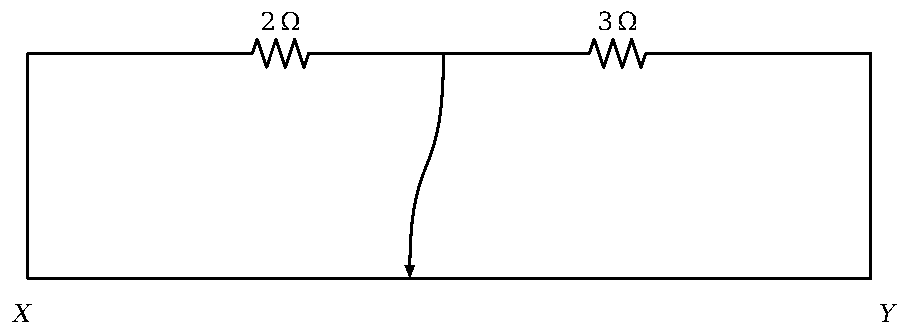
connected in parallel with $3\Omega$ resistor, the null point is shifted by 22.5 cm toward $Y$. The resistance of unknown resistor is ____ $\Omega$.
- A.3
- B.1
- C.4
- D.2
Show answer & solution
Correct answer: D – 2
SolutionInitially on the $100\text{ cm}$ meter bridge wire, $\frac{l_1}{100 - l_1} = \frac{2}{3} \implies 3l_1 = 200 - 2l_1 \implies l_1 = 40\text{ cm}$. After shifting $22.5\text{ cm}$ toward $Y$, the new balance length is $l_2 = 40 + 22.5 = 62.5\text{ cm}$, so $\frac{2}{R_p} = \frac{62.5}{37.5} = \frac{5}{3} \implies R_p = \frac{6}{5} = 1.2\,\Omega$. For $R$ in parallel with $3\,\Omega$: $\frac{3R}{3 + R} = 1.2 \implies 3R = 3.6 + 1.2R \implies 1.8R = 3.6 \implies R = 2\,\Omega$.
Question 9
Density of water at $4^{\circ}\mathrm{C}$ and $20^{\circ}\mathrm{C}$ are $1000\mathrm{kg}/\mathrm{m}^{3}$ and $998\mathrm{kg}/\mathrm{m}^{3}$ respectively. The increase in internal energy of 4 kg of water when it is heated from $4^{\circ}\mathrm{C}$ to $20^{\circ}\mathrm{C}$ is ____ J.
(specific heat capacity of water $=4.2\mathrm{J}/\mathrm{kg}$. and 1 atmospheric pressure $=10^{5}\mathrm{Pa}$ )
(specific heat capacity of water $=4.2\mathrm{J}/\mathrm{kg}$. and 1 atmospheric pressure $=10^{5}\mathrm{Pa}$ )
- A.268799.2
- B.315826.2
- C.234699.2
- D.258700.8
Show answer & solution
Correct answer: A – 268799.2
SolutionHeat supplied (using $c = 4.2\text{ kJ/kg}\cdot\text{K} = 4200\text{ J/kg}\cdot\text{K}$): $Q = m c \Delta T = 4 \times 4200 \times (20 - 4) = 268800\text{ J}$. Volume change $\Delta V = m\left(\frac{1}{\rho_2} - \frac{1}{\rho_1}\right) = 4\left(\frac{1}{998} - \frac{1}{1000}\right) \approx 8.0 \times 10^{-6}\text{ m}^3$, so expansion work $W = P_0 \Delta V = 10^5 \times 8.0 \times 10^{-6} = 0.8\text{ J}$. By the first law, $\Delta U = Q - W = 268800 - 0.8 = 268799.2\text{ J}$.
Question 10
A boy throws a ball into air at $45^{\circ}$ from the horizontal to land it on a roof of a building of height $H$. If the ball attains maximum height in 2 s and lands on the building in 3 s after launch, then value of $H$ is ____ m.
$\left( \mathrm{g}=10\mathrm{m}/\mathrm{s}^{2} \right)$
$\left( \mathrm{g}=10\mathrm{m}/\mathrm{s}^{2} \right)$
- A.20
- B.25
- C.10
- D.15
Show answer & solution
Correct answer: D – 15
SolutionTime to reach maximum height is $t_{\max} = \frac{u_y}{g} = 2\text{ s} \implies u_y = 20\text{ m/s}$. Vertical height at $t = 3\text{ s}$ is $H = u_y t - \frac{1}{2}gt^2 = 20(3) - \frac{1}{2}(10)(3)^2 = 60 - 45 = 15\text{ m}$.
Question 11
A cylindrical block of mass $M$ and area of cross section $A$ is floating in a liquid of density $\rho$ and with its axis vertical. When depressed a little and released the block starts oscillating. The period of oscillation is ____
- A.$2\pi\sqrt{\frac{\rho A}{Mg}}$
- B.$\pi\sqrt{\frac{2M}{\rho Ag}}$
- C.$2\pi\sqrt{\frac{M}{\rho Ag}}$
- D.$\pi\sqrt{\frac{\rho A}{Mg}}$
Show answer & solution
Correct answer: C – $2\pi\sqrt{\frac{M}{\rho Ag}}$
SolutionWhen depressed by a small displacement $y$, the extra buoyant restoring force is $F = -(\rho A y)g = -(\rho A g)y$, giving effective spring constant $k = \rho A g$. Time period $T = 2\pi\sqrt{\frac{M}{k}} = 2\pi\sqrt{\frac{M}{\rho A g}}$.
Question 12
A spring of force constant $15\mathrm{N}/\mathrm{m}$ is cut into two pieces. If the ratio of their length is $1:3$, then the force constant of smaller piece is ____ $\mathrm{N}/\mathrm{m}$.
- A.20
- B.45
- C.60
- D.15
Show answer & solution
Correct answer: C – 60
SolutionLength of the smaller piece is $l_1 = \frac{1}{1 + 3}L = \frac{L}{4}$. Since spring constant $k \propto \frac{1}{l}$, $k_1 = 4k = 4 \times 15 = 60\text{ N/m}$.
Question 13
The electrostatic potential in a charged spherical region of radius $r$ varies as $V$ $=ar^{3}+b$, where $a$ and $b$ are constants. The total charge in the sphere of unit radius is $\alpha\times\pi a\in{}_{0}$. The value of $\alpha$ is ____. (permittivity of vacuum is $\epsilon_{0}$ )
- A.-12
- B.-8
- C.-9
- D.-6
Show answer & solution
Correct answer: A – -12
SolutionRadial electric field $E_r = -\frac{dV}{dr} = -3ar^2$. By Gauss's law at $r = 1\text{ m}$, total enclosed charge $Q = \epsilon_0 E_r (4\pi r^2) = \epsilon_0 (-3a(1)^2)(4\pi(1)^2) = -12\pi a \epsilon_0$, so $\alpha = -12$.
Question 14
There are three co-centric conducting spherical shells $A,B$ and $C$ of radii $a,b$ and $c$ respectively ($c\gt $ $b\gt a$ ) and they are charged with charge $q_{1},q_{2}$ and $q_{3}$ respectively. The potentials of the spheres $A,B$ and $C$ respectively, are:
- A.$\frac{1}{4\pi\epsilon_{\mathrm{o}}}\ \left( \frac{q_{1}}{a}+\frac{q_{2}}{b}+\frac{q_{3}}{c} \right),\frac{1}{4\pi\epsilon_{\mathrm{o}}}\ \left( \frac{q_{1}+q_{2}+q_{3}}{b} \right),\frac{1}{4\pi\epsilon_{\mathrm{o}}}\ \left( \frac{q_{1}+q_{2}+q_{3}}{c} \right)$
- B.$\frac{1}{4\pi\epsilon_{\mathrm{o}}}\ \left( \frac{q_{1}+q_{2}+q_{3}}{a} \right),\frac{1}{4\pi\epsilon_{\mathrm{o}}}\ \left( \frac{q_{1}+q_{2}+q_{3}}{b} \right),\frac{1}{4\pi\epsilon_{\mathrm{o}}}\ \left( \frac{q_{1}+q_{2}+q_{3}}{c} \right)$
- C.$\frac{1}{4\pi\epsilon_{\mathrm{o}}}\ \left( \frac{q_{1}+q_{2}+q_{3}}{a} \right),\frac{1}{4\pi\epsilon_{\mathrm{o}}}\ \left( \frac{q_{1}+q_{2}}{b}+\frac{q_{3}}{c} \right),\frac{1}{4\pi\epsilon_{\mathrm{o}}}\ \left( \frac{q_{1}}{a}+\frac{q_{2}}{b}+\frac{q_{3}}{c} \right)$
- D.$\frac{1}{4\pi\epsilon_{\mathrm{o}}}\ \left( \frac{q_{1}}{a}+\frac{q_{2}}{b}+\frac{q_{3}}{c} \right),\frac{1}{4\pi\epsilon_{\mathrm{o}}}\ \left( \frac{q_{1}+q_{2}}{b}+\frac{q_{3}}{c} \right),\frac{1}{4\pi\epsilon_{\mathrm{o}}}\ \left( \frac{q_{1}+q_{2}+q_{3}}{c} \right)$
Show answer & solution
Correct answer: D – $\frac{1}{4\pi\epsilon_{\mathrm{o}}}\ \left( \frac{q_{1}}{a}+\frac{q_{2}}{b}+\frac{q_{3}}{c} \right),\frac{1}{4\pi\epsilon_{\mathrm{o}}}\ \left( \frac{q_{1}+q_{2}}{b}+\frac{q_{3}}{c} \right),\frac{1}{4\pi\epsilon_{\mathrm{o}}}\ \left( \frac{q_{1}+q_{2}+q_{3}}{c} \right)$
SolutionUsing superposition for concentric shells ($a < b < c$): $V_A = \frac{1}{4\pi\epsilon_0}\left(\frac{q_1}{a} + \frac{q_2}{b} + \frac{q_3}{c}\right)$, $V_B = \frac{1}{4\pi\epsilon_0}\left(\frac{q_1 + q_2}{b} + \frac{q_3}{c}\right)$, and $V_C = \frac{1}{4\pi\epsilon_0}\left(\frac{q_1 + q_2 + q_3}{c}\right)$, matching option (D).
Question 15
Three charges $+2q,+3q$ and $-4q$ are situated at $(0,-3a),(2a,0)$ and $(-2a,0)$ respectively in the $xy$ plane. The resultant dipole moment about origin is ____.
- A.$2qa(7\hat{i}-3\hat{j})$
- B.$2qa(3\hat{j}-7\hat{i})$
- C.$2qa(3\hat{i}-7\hat{j})$
- D.$2qa(3\hat{j}-\hat{i})$
Show answer & solution
Correct answer: A – $2qa(7\hat{i}-3\hat{j})$
SolutionResultant dipole moment about the origin $\vec{p} = \sum q_i \vec{r}_i = (+2q)(-3a\hat{j}) + (+3q)(2a\hat{i}) + (-4q)(-2a\hat{i}) = -6qa\hat{j} + 6qa\hat{i} + 8qa\hat{i} = 14qa\hat{i} - 6qa\hat{j} = 2qa(7\hat{i} - 3\hat{j})$.
60 more questions in this paper
Real exam window with timer, instant score, rank and topic-wise analysis.
Get GoMocks Pass (all papers)Already enrolled? Start now
Paper details
Questions75
Time180 min
Marks300
Year2026
60 more questions in this paper
Real exam window with timer, instant score, rank and topic-wise analysis.
Get GoMocks Pass (all papers)Already enrolled? Start now
More JEE Mains papers
JEE Main 2026 - 28 Jan 2026 - 28 Jan Shift 2
JEE Main 2026 - 28 Jan 2026 - 28 Jan Shift 1
JEE Main 2026 - 24 Jan 2026 - 24 Jan Shift 2
JEE Main 2026 - 04 Apr 2026 - 4 Apr Shift 1
JEE Main 2026 - 02 Apr 2026 - 2 Apr Shift 2
JEE Main 2026 - 02 Apr 2026 - 2 Apr Shift 1
JEE Main 2026 - 01/23/26 - 23 Jan Shift 2
JEE Main 2026 - 01/23/26 - 23 Jan Shift 1
JEE Main 2026 - 01/22/26 - 22 Jan Shift 2
JEE Main 2026 - 01/22/26 - 22 Jan Shift 1
JEE Main 2026 - 01/21/26 - 21 Jan Shift 2
JEE Main 2026 - 01/21/26 - 21 Jan Shift 1
All JEE Mains previous year papers →