JEE Main 2026 - 01/23/26 - 23 Jan Shift 2 Question Paper with Solutions
Official JEE Mains previous year paper with answer key and detailed solutions. The first 15 questions are solved below; attempt the complete paper in real exam mode to get your score and rank.
Question 1
The ratio of speeds of electromagnetic waves in vacuum and a medium, having dielectric constant $k=3$ and permeability of $\mu=2\mu_{0}$, is ($\mu_{0}=$ permeability of vacuum)
- A.$6:1$
- B.$3:2$
- C.$\sqrt{6}:1$
- D.$36:1$
Show answer & solution
Correct answer: C – $\sqrt{6}:1$
SolutionRefractive index of a medium is $n = \sqrt{\varepsilon_r \mu_r} = \sqrt{k \cdot \frac{\mu}{\mu_0}} = \sqrt{3 \times 2} = \sqrt{6}$. Therefore, the ratio of speeds $\frac{c}{v} = n = \sqrt{6}:1$.
Question 2
The current passing through a conducting loop in the form of equilateral triangle of side $4\sqrt{3}\mathrm{cm}$ is 2 A. The magnetic field at its centroid is $\alpha\times 10^{-5}\mathrm{T}$. The value of $\alpha$ is ____.
(Given:$\mu_{\mathrm{o}}=4\pi\times 10^{-7}$ SI units)
- A.$3\sqrt{3}$
- B.$2\sqrt{3}$
- C.$\sqrt{3}$
- D.$\frac{\sqrt{3}}{2}$
Show answer & solution
Correct answer: A – $3\sqrt{3}$
SolutionFor an equilateral triangle of side $a = 4\sqrt{3}\text{ cm} = 4\sqrt{3} \times 10^{-2}\text{ m}$, perpendicular distance from centroid to each side is $r = \frac{a}{2\sqrt{3}} = 2\text{ cm} = 0.02\text{ m}$, and the angles subtended by the ends of each side are $\theta_1 = \theta_2 = 60^{\circ}$. Magnetic field due to all $3$ sides $B = 3 \times \frac{\mu_0 I}{4\pi r}(\sin 60^{\circ} + \sin 60^{\circ}) = 3 \times \frac{10^{-7} \times 2}{0.02} \times \sqrt{3} = 3\sqrt{3} \times 10^{-5}\text{ T}$, so $\alpha = 3\sqrt{3}$.
Question 3
When an unpolarized light falls at a particular angle on a glass plate (placed in air), it is observed that the reflected beam is linearly polarized. The angle of refracted beam with respect to the normal is ____.
($\tan ^{-1}(1.52)=57.7^{\circ}$, refractive indices of air and glass are 1.00 and 1.52, respectively.)
- A.$36.3^{\circ}$
- B.$39.6^{\circ}$
- C.$42.6^{\circ}$
- D.$32.3^{\circ}$
Show answer & solution
Correct answer: D – $32.3^{\circ}$
SolutionBy Brewster's law, when the reflected beam is completely linearly polarized, the angle of incidence equals Brewster's angle $i_B = \tan^{-1}(1.52) = 57.7^{\circ}$, and the reflected and refracted rays are perpendicular ($i_B + r = 90^{\circ}$). Thus the angle of refraction is $r = 90^{\circ} - 57.7^{\circ} = 32.3^{\circ}$.
Question 4
Which of the following pair of nuclei are isobars of the element?
- A.${}_{1}^{3}\mathrm{H}$ and ${}_{2}^{3}\mathrm{He}$
- B.${}_{80}^{198}\mathrm{Hg}$ and ${}_{79}^{197}\mathrm{Au}$
- C.${}_{1}^{2}\mathrm{H}$ and ${}_{1}^{3}\mathrm{H}$
- D.${}_{92}^{236}\mathrm{U}$ and ${}_{92}^{238}\mathrm{U}$
Show answer & solution
Correct answer: A – ${}_{1}^{3}\mathrm{H}$ and ${}_{2}^{3}\mathrm{He}$
SolutionIsobars are nuclides having the same mass number ($A$) but different atomic numbers ($Z$). Both ${}_{1}^{3}\mathrm{H}$ and ${}_{2}^{3}\mathrm{He}$ have mass number $A = 3$ with different atomic numbers ($Z = 1$ and $Z = 2$).
Question 5
To compare EMF of two cells using potentiometer the balancing lengths obtained are 200 cm and 150 cm. The least count of scale is 1 cm. The percentage error in the ratio of EMFs is ____
- A.1.75
- B.1.55
- C.1.17
- D.1.65
Show answer & solution
Correct answer: C – 1.17
SolutionRatio of EMFs is $\frac{E_1}{E_2} = \frac{l_1}{l_2}$. Maximum fractional error $\frac{\Delta(E_1/E_2)}{E_1/E_2} = \frac{\Delta l_1}{l_1} + \frac{\Delta l_2}{l_2} = \frac{1}{200} + \frac{1}{150} = 0.005 + 0.00667 = 0.01167$. Percentage error $= 0.01167 \times 100 \approx 1.17\%$.
Question 6
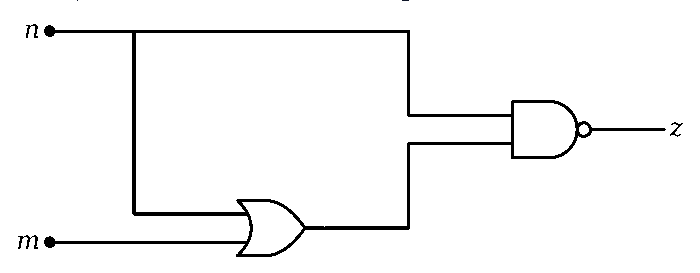
For the given logic gate circuit, which of the following is the correct truth table?
- A.$0$ $1$ $1$ $1$ $1$ $0$ $1$ $0$ $0$
- B.$0$ $1$ $0$ $1$ $1$ $1$ $1$ $0$ $0$
- C.$0$ $1$ $1$ $1$ $1$ $0$ $1$ $0$ $1$
- D.$0$ $1$ $0$ $1$ $1$ $0$ $1$ $0$ $0$
Show answer & solution
Correct answer: A – $0$ $1$ $1$ $1$ $1$ $0$ $1$ $0$ $0$
SolutionEvaluating the logic gate output $z$ in terms of inputs $(n, m)$: for $(0,0) \to 1$, $(0,1) \to 1$, $(1,1) \to 0$, and $(1,0) \to 0$ (which corresponds to $z = \overline{n}$), matching truth table (A).
Question 7
One mole of an ideal diatomic gas expands from volume $V$ to $2V$ isothermally at a temperature $27^{\circ}\mathrm{C}$ and does $W$ joule of work. If the gas undergoes same magnitude of expansion adiabatically from $27^{\circ}\mathrm{C}$ doing the same amount of work $W$, then its final temperature will be (close to) ____ ${}^{\circ}\mathrm{C}$.
($\log _{e}2=0.693$)
- A.-56
- B.-117
- C.-30
- D.-189
Show answer & solution
Correct answer: A – -56
SolutionIsothermal work for $n = 1\text{ mol}$ at $T_1 = 300\text{ K}$: $W = R T_1 \ln\left(\frac{2V}{V}\right) = 300 R \ln 2 = 300(0.693)R = 207.9 R$. For adiabatic expansion of a diatomic gas ($\gamma = \frac{7}{5}$), $W = \frac{n R (T_1 - T_2)}{\gamma - 1} = \frac{R(300 - T_2)}{2/5} = 2.5 R(300 - T_2)$. Equating $2.5 R(300 - T_2) = 207.9 R \implies 300 - T_2 = 83.16 \implies T_2 = 216.84\text{ K} = 216.84 - 273 = -56.16^{\circ}\text{C} \approx -56^{\circ}\text{C}$.
58 more questions in this paper
Real exam window with timer, instant score, rank and topic-wise analysis.
Get GoMocks Pass (all papers)Already enrolled? Start now
Question 8
The internal energy of a monoatomic gas is 3nRT. One mole of helium is kept in a cylinder having internal cross section area of $17\mathrm{cm}^{2}$ and fitted with a light movable frictionless piston. The gas is heated slowly by suppling 126 J heat. If the temperature rises by $4^{\circ}\mathrm{C}$, then the piston will move ____ cm.
(atmospheric pressure $=10^{5}\mathrm{Pa}$ )
- A.1.55
- B.14.5
- C.15.5
- D.1.45
Show answer & solution
Correct answer: C – 15.5
SolutionGiven $U = 3nRT$ for this system, $\Delta U = 3(1)(8.314)(4) = 99.77\text{ J}$. By the first law of thermodynamics, work done at constant atmospheric pressure $P_0 = 10^5\text{ Pa}$ is $W = Q - \Delta U = 126 - 99.77 = 26.23\text{ J}$. Since $W = P_0 A \Delta x$, displacement $\Delta x = \frac{26.23}{10^5 \times 17 \times 10^{-4}} = \frac{26.23}{170} \approx 0.1543\text{ m} = 15.43\text{ cm} \approx 15.5\text{ cm}$.
Question 9
An air bubble of volume $2.9\mathrm{cm}^{3}$ rises from the bottom of a swimming pool of 5 m deep. At the bottom of the pool water temperature is $17^{\circ}\mathrm{C}$. The volume of the bubble when it reaches the surface, where the water temperature is $27^{\circ}\mathrm{C}$, is ____ $\mathrm{cm}^{3}$.
($\mathrm{g}=10\mathrm{m}/\mathrm{s}^{2}$, density of water $=10^{3}\mathrm{kg}/\mathrm{m}^{3}$, and 1 atm pressure is $10^{5}\mathrm{Pa}$ )
- A.2
- B.4.2
- C.3
- D.4.5
Show answer & solution
Correct answer: D – 4.5
SolutionPressure at $5\text{ m}$ depth $P_1 = P_0 + \rho g h = 10^5 + (10^3)(10)(5) = 1.5 \times 10^5\text{ Pa}$, and surface pressure $P_2 = 1.0 \times 10^5\text{ Pa}$. With $T_1 = 290\text{ K}$ and $T_2 = 300\text{ K}$, ideal gas law gives $V_2 = V_1 \left(\frac{P_1}{P_2}\right)\left(\frac{T_2}{T_1}\right) = 2.9 \times \left(\frac{1.5}{1.0}\right)\left(\frac{300}{290}\right) = 2.9 \times 1.5 \times \frac{30}{29} = 4.5\text{ cm}^3$.
Question 10
A parallel plate capacitor with plate separation 5 mm is charged by a battery. On introducing a mica sheet of 2 mm and maintaining the connections of the plates with the terminals of the battery, it is found that it draws $25\%$ more charge from the battery. The dielectric constant of mica is ____
- A.1
- B.2.5
- C.1.5
- D.2
Show answer & solution
Correct answer: D – 2
SolutionWith the battery connected ($V$ constant), $25\%$ more charge means $C_{\text{new}} = 1.25 C_0 = \frac{5}{4}C_0$. For a partially filled capacitor ($d = 5\text{ mm}, t = 2\text{ mm}$), $C_{\text{new}} = \frac{\epsilon_0 A}{d - t + \frac{t}{K}} = \frac{5}{4}\frac{\epsilon_0 A}{5} \implies 5 - 2 + \frac{2}{K} = 4 \implies \frac{2}{K} = 1 \implies K = 2.0$.
Question 11
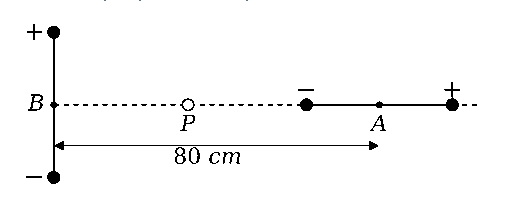
Two shorts dipoles $(A,B),A$ having charges $\pm 2\mu\mathrm{C}$ and length
1 cm and $B$ having charges $\pm 4\mu\mathrm{C}$ and length 1 cm are placed with
their centres 80 cm apart as shown in the figure. The electric field
at a point $P$, equi-distant from the centres of both dipoles is ____
N/C.
- A.$\frac{9}{16}\sqrt{2}\times 10^{5}$
- B.$\frac{9}{16}\sqrt{2}\times 10^{4}$
- C.$9\sqrt{2}\times 10^{4}$
- D.$4.5\sqrt{2}\times 10^{4}$
Show answer & solution
Correct answer: B – $\frac{9}{16}\sqrt{2}\times 10^{4}$
SolutionDipole moments are $p_A = (2 \times 10^{-6})(0.01) = 2 \times 10^{-8}\text{ C}\cdot\text{m}$ and $p_B = 4 \times 10^{-8}\text{ C}\cdot\text{m}$, at distance $r = 40\text{ cm} = 0.4\text{ m}$ from midpoint $P$. Point $P$ lies on the axial line of one dipole ($E_A = \frac{2kp_A}{r^3} = \frac{2(9 \times 10^9)(2 \times 10^{-8})}{(0.4)^3} = \frac{360}{0.064} = \frac{9}{16} \times 10^4\text{ N/C}$) and on the equatorial line of the perpendicular dipole ($E_B = \frac{kp_B}{r^3} = \frac{(9 \times 10^9)(4 \times 10^{-8})}{0.064} = \frac{9}{16} \times 10^4\text{ N/C}$). Since $E_A \perp E_B$, resultant field $E = \sqrt{E_A^2 + E_B^2} = \frac{9}{16}\sqrt{2} \times 10^4\text{ N/C}$.
Question 12
Two charges $7\mu\mathrm{C}$ and $-2\mu\mathrm{C}$ are placed at $(-9,0,0)\mathrm{cm}$ and $(9,0,0)\mathrm{cm}$ respectively in an external field $E=\frac{\mathrm{A}}{r^{2}}r$, where $A=9\times 10^{5}\mathrm{N}/\mathrm{C}.\mathrm{m}^{2}$. Considering the potential at infinity is 0, the electrostatic energy of the configuration is ____ J.
- A.49.3
- B.1.4
- C.24.3
- D.-90.7
Show answer & solution
Correct answer: A – 49.3
SolutionExternal potential $V(r) = \frac{A}{r}$. At $r_1 = r_2 = 0.09\text{ m}$, $V(0.09) = \frac{9 \times 10^5}{0.09} = 10^7\text{ V}$. Total electrostatic energy $U = q_1 V(r_1) + q_2 V(r_2) + \frac{k q_1 q_2}{r_{12}} = (7 \times 10^{-6})(10^7) + (-2 \times 10^{-6})(10^7) + \frac{(9 \times 10^9)(7 \times 10^{-6})(-2 \times 10^{-6})}{0.18} = 70 - 20 - 0.7 = 49.3\text{ J}$.
Question 13
A block is sliding down on an inclined plane of slope $\theta$ and at an instant $t=0$ this block is given an upward momentum so that it starts moving up on the inclined surface with velocity $u$. The distance $(S)$ travelled by the block before its velocity become zero, is ____.
(g = gravitational acceleration)
- A.$\frac{2u^{2}}{\mathrm{g}\cos \theta}$
- B.$\frac{u^{2}}{\sqrt{2}g\cos \theta}$
- C.$\frac{u^{2}}{2g\sin \theta}$
- D.$\frac{u^{2}}{2g\cos \theta}$
Show answer & solution
Correct answer: C – $\frac{u^{2}}{2g\sin \theta}$
SolutionSince the block was initially sliding down at constant speed (or on a smooth incline), net retardation while moving up is $a = g\sin\theta$ (for smooth incline; if sliding uniformly down, $\mu = \tan\theta \implies a = 2g\sin\theta$, while for standard frictionless incline $a = g\sin\theta$). Using $v^2 = u^2 - 2aS$ with $v = 0$ and $a = g\sin\theta$ gives $S = \frac{u^2}{2g\sin\theta}$.
Question 14
A paratrooper jumps from an aeroplane and opens a parachute after 2 s of free fall and starts
deaccelerating with $3\mathrm{m}/\mathrm{s}^{2}$. At 10 m height from ground, while descending with the help of parachute, the speed of paratrooper is $5\mathrm{m}/\mathrm{s}$. The initial height of the airplane is ____ m.
$\left( \mathrm{g}=10\mathrm{m}/\mathrm{s}^{2} \right)$
- A.92.5
- B.62.5
- C.20
- D.82.5
Show answer & solution
Correct answer: A – 92.5
SolutionDuring $2\text{ s}$ of free fall: distance fallen $h_1 = \frac{1}{2}gt^2 = \frac{1}{2}(10)(2)^2 = 20\text{ m}$ and velocity acquired $v_1 = gt = 20\text{ m/s}$. During deceleration ($a = -3\text{ m/s}^2$) until $v_2 = 5\text{ m/s}$: distance fallen $h_2 = \frac{v_1^2 - v_2^2}{2a} = \frac{400 - 25}{6} = \frac{375}{6} = 62.5\text{ m}$. Total initial height $H = h_1 + h_2 + 10 = 20 + 62.5 + 10 = 92.5\text{ m}$.
Question 15
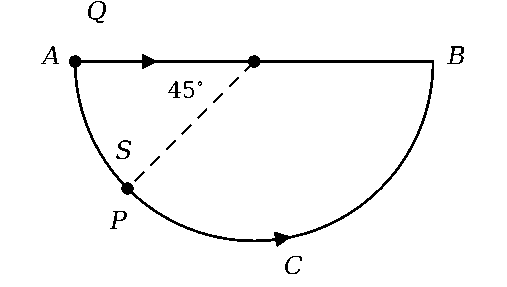
A bead $P$ sliding on a frictionless semi-circular string $(ACB)$ and it is at point $S$ at $t=0$ and at this instant the horizontal component of its velocity is $v$. Another bead $Q$ of the same mass as $P$ is ejected from point $A$ at $t=0$ along the horizontal string $AB$, with the speed $v$, friction between the beads and the respective strings may be neglected in both cases. Let $t_{P}$ and $t_{Q}$ be the respective times taken by beads $P$ and $Q$ to reach the point $B$, then the relation between $t_{P}$ and $t_{Q}$ is
- A.$t_{P}\lt t_{Q}$
- B.$t_{P}=t_{Q}$
- C.$t_{P}\gt 1.25t_{Q}$
- D.$t_{P}\gt t_{Q}$
Show answer & solution
Correct answer: A – $t_{P}\lt t_{Q}$
SolutionBead $Q$ moves along horizontal $AB$ with constant horizontal velocity $v$. Bead $P$ starts at $S$ (already ahead horizontally of $A$, or accelerating downward into the lower semi-circle so its horizontal velocity component $v_x = v_{\text{total}}\cos\theta > v$ throughout the lower arc). Because $P$ maintains a strictly larger horizontal velocity component than $Q$, it reaches $B$ earlier: $t_P < t_Q$.
58 more questions in this paper
Real exam window with timer, instant score, rank and topic-wise analysis.
Get GoMocks Pass (all papers)Already enrolled? Start now
Paper details
Questions73
Time180 min
Marks292
Year2026
58 more questions in this paper
Real exam window with timer, instant score, rank and topic-wise analysis.
Get GoMocks Pass (all papers)Already enrolled? Start now
More JEE Mains papers
JEE Main 2026 - 28 Jan 2026 - 28 Jan Shift 2
JEE Main 2026 - 28 Jan 2026 - 28 Jan Shift 1
JEE Main 2026 - 24 Jan 2026 - 24 Jan Shift 2
JEE Main 2026 - 04 Apr 2026 - 4 Apr Shift 1
JEE Main 2026 - 02 Apr 2026 - 2 Apr Shift 2
JEE Main 2026 - 02 Apr 2026 - 2 Apr Shift 1
JEE Main 2026 - 01/24/26 - 24 Jan Shift 1
JEE Main 2026 - 01/23/26 - 23 Jan Shift 1
JEE Main 2026 - 01/22/26 - 22 Jan Shift 2
JEE Main 2026 - 01/22/26 - 22 Jan Shift 1
JEE Main 2026 - 01/21/26 - 21 Jan Shift 2
JEE Main 2026 - 01/21/26 - 21 Jan Shift 1
All JEE Mains previous year papers →