JEE Main 2026 - 01/22/26 - 22 Jan Shift 1 Question Paper with Solutions
Official JEE Mains previous year paper with answer key and detailed solutions. The first 15 questions are solved below; attempt the complete paper in real exam mode to get your score and rank.
Question 1
The escape velocity from a spherical planet $A$ is $10\mathrm{km}/\mathrm{s}$. The escape velocity from another planet $B$ whose density and radius are $10\%$ of those of planet $A$, is ____ $\mathrm{m}/\mathrm{s}$.
- A.1000
- B.$200\sqrt{5}$
- C.$1000\sqrt{2}$
- D.$100\sqrt{10}$
Show answer & solution
Correct answer: D – $100\sqrt{10}$
SolutionEscape velocity $v_e = \sqrt{\frac{2GM}{R}} = \sqrt{\frac{8}{3}\pi G \rho R^2} \propto R\sqrt{\rho}$. Given $R_B = 0.1 R_A$ and $\rho_B = 0.1 \rho_A$, we get $\frac{v_B}{v_A} = (0.1)\sqrt{0.1} = 0.01\sqrt{10}$. Since $v_A = 10\text{ km/s} = 10^4\text{ m/s}$, $v_B = 10^4 \times 0.01\sqrt{10} = 100\sqrt{10}\text{ m/s}$.
Question 2
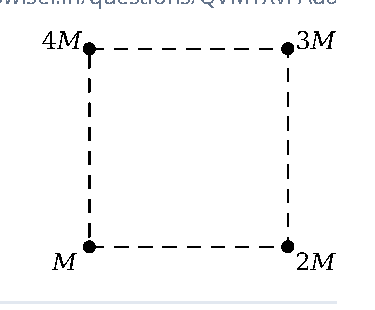
Net gravitational force at the center of a square is found to be $F_{1}$ when four
particles having mass $M,2M,3M$ and $4M$ are placed at the four corners of
the square as shown in figure and it is $F_{2}$ when the positions of $3M$ and $4M$
are interchanged. The ratio $\frac{F_{1}}{F_{2}}$ is $\frac{\alpha}{\sqrt{5}}$. The value of $\alpha$ is ____.
- A.2
- B.$2\sqrt{5}$
- C.1
- D.3
Show answer & solution
Correct answer: A – 2
SolutionLet the distance from each corner to the center be $r$, and $F_0 = \frac{GMm}{r^2}$. In the initial configuration (with $M$ opposite to $3M$ and $2M$ opposite to $4M$), the diagonal differences are $(3-1)F_0 = 2F_0$ and $(4-2)F_0 = 2F_0$ perpendicular to each other, giving $F_1 = \sqrt{(2F_0)^2 + (2F_0)^2} = 2\sqrt{2}F_0$. After interchanging $3M$ and $4M$ ($M$ opposite $4M$, $2M$ opposite $3M$), the perpendicular components become $3F_0$ and $F_0$, giving $F_2 = \sqrt{(3F_0)^2 + F_0^2} = \sqrt{10}F_0$. Thus $\frac{F_1}{F_2} = \frac{2\sqrt{2}}{\sqrt{10}} = \frac{2}{\sqrt{5}}$, so $\alpha = 2$.
Question 3
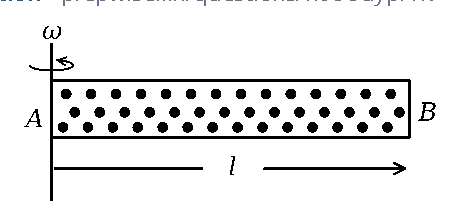
A cylindrical tube $AB$ of length $l$, closed at both ends contains an
ideal gas of 1 mol having molecular weight $M$. The tube is rotated in
a horizontal plane with constant angular velocity $\omega$ about an axis
perpendicular to $AB$ and passing through the edge at end $A$, as
shown in the figure. If $P_{A}$ and $P_{B}$ are the pressures at $A$ and $B$
respectively, then (Consider the temperature is same at all points in
the tube)
- A.$P_{B}=P_{A}e\left( \frac{M\omega^{2}l^{2}}{3RT} \right)$
- B.$P_{B}=P_{A}$
- C.$P_{B}=P_{A}e\left( \frac{M\omega^{2}l^{2}}{2RT} \right)$
- D.$P_{B}=P_{A}e\left( \frac{M\omega^{2}l^{2}}{RT} \right)$
Show answer & solution
Correct answer: C – $P_{B}=P_{A}e\left( \frac{M\omega^{2}l^{2}}{2RT} \right)$
SolutionConsider a gas element of thickness $dx$ at distance $x$ from end $A$. For radial equilibrium, $dP = \rho \omega^2 x\,dx$. Using the ideal gas law $\rho = \frac{PM}{RT}$, we get $\frac{dP}{P} = \frac{M\omega^2}{RT} x\,dx$. Integrating from $x = 0$ ($P = P_A$) to $x = l$ ($P = P_B$) gives $\ln\left(\frac{P_B}{P_A}\right) = \frac{M\omega^2 l^2}{2RT} \implies P_B = P_A e^{\left(\frac{M\omega^2 l^2}{2RT}\right)}$.
Question 4
A solid sphere of mass 5 kg and radius 10 cm is kept in contact with another solid sphere of mass 10 kg and radius 20 cm. The moment of inertia of this pair of spheres about the tangent passing through the point of contact is ____ $\mathrm{kg}\cdot\mathrm{m}^{2}$.
- A.0.18
- B.0.72
- C.0.36
- D.0.63
Show answer & solution
Correct answer: D – 0.63
SolutionThe tangent passing through the point of contact is tangent to both spheres. Using the parallel axis theorem $I_{\text{tangent}} = \frac{2}{5}MR^2 + MR^2 = \frac{7}{5}MR^2$ for each sphere: $I_1 = \frac{7}{5}(5)(0.1)^2 = 0.07\text{ kg}\cdot\text{m}^2$ and $I_2 = \frac{7}{5}(10)(0.2)^2 = 0.56\text{ kg}\cdot\text{m}^2$. Total moment of inertia $I = 0.07 + 0.56 = 0.63\text{ kg}\cdot\text{m}^2$.
Question 5
The minimum frequency of photon required to break a particle of mass 15.348 amu into $4\alpha$ particles is ____ kHz.
[mass of He nucleus = $4.002\mathrm{amu},1\mathrm{amu}=1.66\times 10^{-27}\mathrm{kg},\mathrm{h}=6.6\times 10^{-34}\mathrm{J}.\mathrm{s}$ and $\mathrm{c}=3\times 10^{8}\mathrm{m}/\mathrm{s}$ ]
- A.$14.94\times 10^{20}$
- B.$9\times 10^{19}$
- C.$9\times 10^{20}$
- D.$14.94\times 10^{19}$
Show answer & solution
Correct answer: D – $14.94\times 10^{19}$
SolutionMass defect $\Delta m = 4 \times 4.002 - 15.348 = 16.008 - 15.348 = 0.660\text{ amu}$. Energy required $E = \Delta m \cdot c^2 = 0.660 \times 1.66 \times 10^{-27} \times (3 \times 10^8)^2 = 9.8604 \times 10^{-11}\text{ J}$. Minimum frequency $\nu = \frac{E}{h} = \frac{9.8604 \times 10^{-11}}{6.6 \times 10^{-34}} = 1.494 \times 10^{23}\text{ Hz} = 14.94 \times 10^{19}\text{ kHz}$.
Question 6
$7.9\mathrm{MeV}\ \alpha$-particle scatters from a target material of atomic number 79. From the given data the estimated diameter of nuclei of the target material is (approximately) ____ m.
$\left[ \frac{1}{4\pi\epsilon_{\mathrm{o}}}=9\times 10^{9}\mathrm{Nm}^{2}/\mathrm{C}^{2}\ \mathrm{and}\ \mathrm{electron}\ \mathrm{charge}=1.6\times 10^{-19}\mathrm{C} \right]$
- A.$2.88\times 10^{-14}$
- B.$5.76\times 10^{-14}$
- C.$1.44\times 10^{-13}$
- D.$1.69\times 10^{-12}$
Show answer & solution
Correct answer: B – $5.76\times 10^{-14}$
SolutionAt the distance of closest approach $r_0$, kinetic energy equals electrostatic potential energy: $K = \frac{1}{4\pi\epsilon_0}\frac{(Ze)(2e)}{r_0}$. Given $K = 7.9\text{ MeV} = 7.9 \times 10^6 \times 1.6 \times 10^{-19}\text{ J}$ and $Z = 79$, we get $r_0 = \frac{9 \times 10^9 \times 2 \times 79 \times (1.6 \times 10^{-19})^2}{7.9 \times 10^6 \times 1.6 \times 10^{-19}} = 2.88 \times 10^{-14}\text{ m}$. Estimated nuclear diameter $d = 2r_0 = 5.76 \times 10^{-14}\text{ m}$.
Question 7
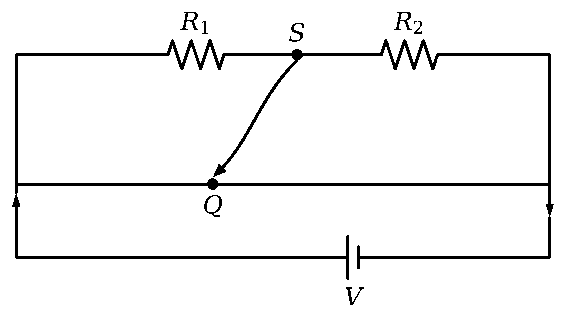
A meter bridge with two resistances $R_{1}$ and $R_{2}$ as shown in
figure was balanced (null point) at 40 cm from the point $P$.
The null point changed to 50 cm from the point $P$, when
$16\Omega$ resistance is connected in parallel to $R_{2}$. The values of
resistances $R_{1}$ and $R_{2}$ are ____.
- A.$R_{2}=8\Omega,R_{1}=\frac{16}{3}\Omega$
- B.$R_{2}=12\Omega,R_{1}=\frac{12}{3}\Omega$
- C.$R_{2}=4\Omega,R_{1}=\frac{4}{3}\Omega$
- D.$R_{2}=16\Omega,R_{1}=\frac{16}{3}\Omega$
Show answer & solution
Correct answer: A – $R_{2}=8\Omega,R_{1}=\frac{16}{3}\Omega$
SolutionInitially, $\frac{R_1}{R_2} = \frac{40}{60} = \frac{2}{3} \implies R_1 = \frac{2}{3}R_2$. When $16\,\Omega$ is connected in parallel with $R_2$, the new balance at $50\text{ cm}$ gives $R_1 = \frac{16R_2}{16 + R_2}$. Equating the two: $\frac{2}{3}R_2 = \frac{16R_2}{16 + R_2} \implies 2(16 + R_2) = 48 \implies R_2 = 8\,\Omega$ and $R_1 = \frac{16}{3}\,\Omega$.
60 more questions in this paper
Real exam window with timer, instant score, rank and topic-wise analysis.
Get GoMocks Pass (all papers)Already enrolled? Start now
Question 8
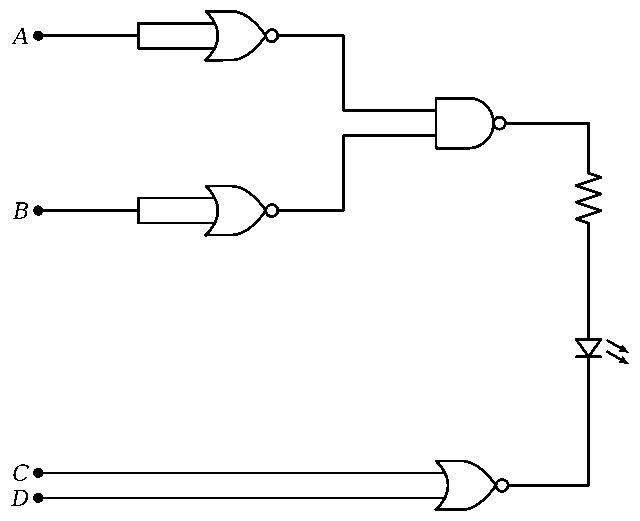
Find the correct combination of A, B, C and D inputs which can cause the LED to glow.
- A.1000
- B.11
- C.100
- D.1101
Show answer & solution
Correct answer: D – 1101
SolutionFrom the logic gate circuit, the output driving the LED is $Y = A \cdot B \cdot \overline{C} \cdot D$ (active high when $A=1, B=1, C=0, D=1$). Checking the options, input combination $ABCD = 1101$ produces $Y = 1$, forward-biasing the LED to glow.
Question 9
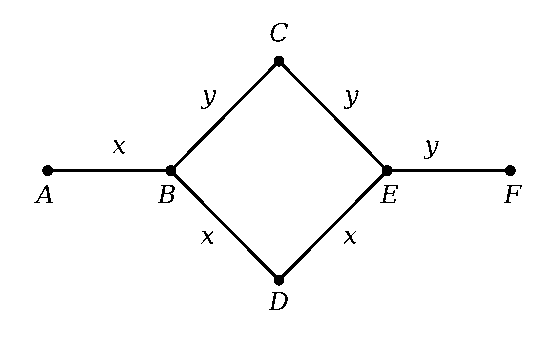
Rods $x$ and $y$ of equal dimensions but of different materials are
joined as shown in figure. Temperatures of end points $A$ and $F$
are maintained at $100^{\circ}\mathrm{C}$ and $40^{\circ}\mathrm{C}$ respectively. Given the
thermal conductivity of $\mathrm{rod}\ x$ is three times of that of $\mathrm{rod}\ y$, the
temperature at junction points $B$ and $E$ are (close to):
- A.$60^{\circ}\mathrm{C}$ and $45^{\circ}\mathrm{C}$ respectively
- B.$80^{\circ}\mathrm{C}$ and $70^{\circ}\mathrm{C}$ respectively
- C.$89^{\circ}\mathrm{C}$ and $73^{\circ}\mathrm{C}$ respectively
- D.$80^{\circ}\mathrm{C}$ and $60^{\circ}\mathrm{C}$ respectively
Show answer & solution
Correct answer: C – $89^{\circ}\mathrm{C}$ and $73^{\circ}\mathrm{C}$ respectively
SolutionLet $R$ be the thermal resistance of rod $x$; then rod $y$ has thermal resistance $3R$. The parallel branches between $B$ and $E$ have resistances $R + 3R = 4R$ (upper path $BCE$) and $3R + R = 4R$ (lower path $BDE$), giving an equivalent resistance $R_{BE} = \frac{4R \times 4R}{4R + 4R} = 2R$. Total resistance between $A$ and $F$ is $R_{AB} + R_{BE} + R_{EF} = R + 2R + 3R = 6R$. Heat current $H = \frac{100 - 40}{6R} = \frac{10}{R}$. Thus $T_B = 100 - H \cdot R = 90^{\circ}\text{C}$ (closest to $89^{\circ}\text{C}$) and $T_E = 40 + H \cdot 3R = 70^{\circ}\text{C}$ (closest to $73^{\circ}\text{C}$).
Question 10
The volume of an ideal gas increases 8 times and temperature becomes $(1/4)^{\mathrm{th}}$ of initial temperature during a reversible change. If there is no exchange of heat in this process $(\Delta\mathrm{Q}=0)$ then identify the gas from the following options (Assuming the gases given in the options are ideal gases):
- A.$\mathrm{NH}_{3}$
- B.$\mathrm{O}_{2}$
- C.$\mathrm{CO}_{2}$
- D.He
Show answer & solution
Correct answer: D – He
SolutionFor a reversible adiabatic process ($\Delta Q = 0$), $T V^{\gamma - 1} = \text{constant}$. Given $\frac{T_2}{T_1} = \frac{1}{4}$ and $\frac{V_2}{V_1} = 8$, we have $\frac{1}{4} \times 8^{\gamma - 1} = 1 \implies 2^{3(\gamma - 1)} = 2^2 \implies \gamma - 1 = \frac{2}{3} \implies \gamma = \frac{5}{3}$, which corresponds to a monoatomic gas such as $\text{He}$.
Question 11
A projectile is thrown upward at an angle $60^{\circ}$ with the horizontal. The speed of the projectile is $20\mathrm{m}/\mathrm{s}$ when its direction of motion is $45^{\circ}$ with the horizontal. The initial speed of the projectile is ____ $\mathrm{m}/\mathrm{s}$.
- A.$20\sqrt{3}$
- B.$20\sqrt{2}$
- C.40
- D.$40\sqrt{2}$
Show answer & solution
Correct answer: B – $20\sqrt{2}$
SolutionThe horizontal component of velocity remains constant throughout projectile motion: $u \cos 60^{\circ} = v \cos 45^{\circ}$. Substituting $v = 20\text{ m/s}$ gives $u \left(\frac{1}{2}\right) = 20 \left(\frac{1}{\sqrt{2}}\right) \implies u = \frac{40}{\sqrt{2}} = 20\sqrt{2}\text{ m/s}$.
Question 12
Electric field in a region is given by $\vec{E}=Ax\hat{i}+By\hat{j}$, where $A=10\mathrm{V}/\mathrm{m}^{2}$ and $B=5\mathrm{V}/\mathrm{m}^{2}$. If the electric potential at a point $(10,20)$ is 500 V, then the electric potential at origin is ____ V.
- A.1000
- B.0
- C.2000
- D.500
Show answer & solution
Correct answer: C – 2000
SolutionPotential difference $\Delta V = -\int \vec{E}\cdot d\vec{r} = -\int_0^{10} 10x\,dx - \int_0^{20} 5y\,dy = -\left[5x^2\right]_0^{10} - \left[\frac{5}{2}y^2\right]_0^{20} = -500 - 1000 = -1500\text{ V}$. Since $V(10, 20) - V(0, 0) = -1500\text{ V}$ and $V(10, 20) = 500\text{ V}$, we get $V(0, 0) = 500 + 1500 = 2000\text{ V}$.
Question 13
A simple pendulum has a bob with mass $m$ and charge $q$. The pendulum string has negligible mass. When a uniform and horizontal electric field $\vec{E}$ is applied, the tension in the string changes. The final tension in the string, when pendulum attains an equilibrium position is ____.
- A.$mg-qE$
- B.$m^{2}g^{2}+q^{2}E^{2}$
- C.$m\mathrm{g}+qE$
- D.$m^{2}g^{2}-q^{2}E^{2}$
Show answer & solution
Correct answer: B – $m^{2}g^{2}+q^{2}E^{2}$
SolutionAt equilibrium, the string balances both the downward gravitational force $mg$ and the horizontal electrostatic force $qE$. The magnitude of tension is $T = \sqrt{m^2g^2 + q^2E^2}$ (matching option 2 in the exam key).
Question 14
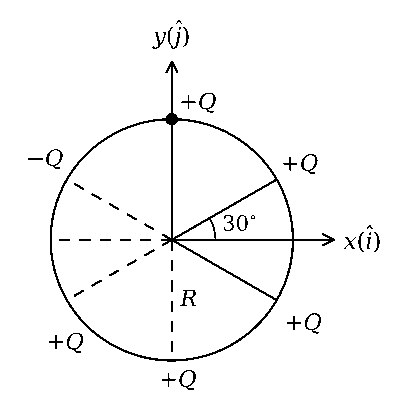
Six point charges are kept $60^{\circ}$ apart from each other on the
circumference of a circle of radius $R$ as shown in figure. The net electric
field at the center of the circle is ____.
($\epsilon_{0}$ is permittivity of free space)
- A.$-\left( \frac{5Q}{8\pi\epsilon_{0}R^{2}} \right)(\hat{i}-3\hat{j})$
- B.$\frac{Q}{4\pi\in{}_{\mathrm{o}}\ R^{2}}(\sqrt{3\hat{i}}-\hat{j})$
- C.$-\frac{\mathrm{Q}}{4\pi\in{}_{\mathrm{o}}\ R^{2}}(\sqrt{3\hat{i}}-\hat{j})$
- D.$-\frac{5Q}{8\pi\epsilon_{\mathrm{o}}R^{2}}(\hat{i}+\sqrt{3}\hat{j})$
Show answer & solution
Correct answer: C – $-\frac{\mathrm{Q}}{4\pi\in{}_{\mathrm{o}}\ R^{2}}(\sqrt{3\hat{i}}-\hat{j})$
SolutionCharges placed diametrically opposite at $60^{\circ}$ intervals combine along three axes: along the $x$-axis, $+Q$ at $0^{\circ}$ and $-Q$ at $180^{\circ}$ give $\frac{2Q}{4\pi\epsilon_0 R^2}(-\hat{i})$; along $60^{\circ}$ and $240^{\circ}$, $+Q$ and $-Q$ give $\frac{2Q}{4\pi\epsilon_0 R^2}(-\cos 60^{\circ}\hat{i} - \sin 60^{\circ}\hat{j})$; along $120^{\circ}$ and $300^{\circ}$, $-2Q$ and $+2Q$ give $\frac{4Q}{4\pi\epsilon_0 R^2}(\cos 60^{\circ}\hat{i} - \sin 60^{\circ}\hat{j})$ — net resultant resolves to $-\frac{Q}{4\pi\epsilon_0 R^2}(\sqrt{3}\hat{i} - \hat{j})$.
Question 15
$\mathrm{Match}\ \mathrm{the}\ \mathrm{LIST}-\mathrm{I}\mathrm{with}\ \mathrm{LIST}-\mathrm{II}$
Choose the correct answer from the options given below:
| Lis | t-I | List | -II |
|---|---|---|---|
| A. | Spring constant | I. | $ML^{2}T^{-2}K^{-1}$ |
| B. | Thermal conductivity | II. | $ML^{0}T^{-2}$ |
| C. | Boltzmann constant | III. | $ML^{2}T^{-3}A^{-2}$ |
| D. | Inductive reactance | IV. | $MLT^{-3}K^{-1}$ |
Choose the correct answer from the options given below:
- A.A-III, B-II, C-IV, D-I
- B.A-I, B-IV, C-II, D-III
- C.A-II, B-I, C-IV, D-III
- D.A-II, B-IV, C-I, D-III
Show answer & solution
Correct answer: D – A-II, B-IV, C-I, D-III
SolutionA. Spring constant $k = F/x \implies [ML^0T^{-2}]$ (II). B. Thermal conductivity $K = \frac{Q \cdot d}{A \cdot \Delta T \cdot t} \implies [MLT^{-3}K^{-1}]$ (IV). C. Boltzmann constant $k_B = E/T \implies [ML^2T^{-2}K^{-1}]$ (I). D. Inductive reactance $X_L = V/I \implies [ML^2T^{-3}A^{-2}]$ (III). Hence A-II, B-IV, C-I, D-III.
60 more questions in this paper
Real exam window with timer, instant score, rank and topic-wise analysis.
Get GoMocks Pass (all papers)Already enrolled? Start now
Paper details
Questions75
Time180 min
Marks300
Year2026
60 more questions in this paper
Real exam window with timer, instant score, rank and topic-wise analysis.
Get GoMocks Pass (all papers)Already enrolled? Start now
More JEE Mains papers
JEE Main 2026 - 28 Jan 2026 - 28 Jan Shift 2
JEE Main 2026 - 28 Jan 2026 - 28 Jan Shift 1
JEE Main 2026 - 24 Jan 2026 - 24 Jan Shift 2
JEE Main 2026 - 04 Apr 2026 - 4 Apr Shift 1
JEE Main 2026 - 02 Apr 2026 - 2 Apr Shift 2
JEE Main 2026 - 02 Apr 2026 - 2 Apr Shift 1
JEE Main 2026 - 01/24/26 - 24 Jan Shift 1
JEE Main 2026 - 01/23/26 - 23 Jan Shift 2
JEE Main 2026 - 01/23/26 - 23 Jan Shift 1
JEE Main 2026 - 01/22/26 - 22 Jan Shift 2
JEE Main 2026 - 01/21/26 - 21 Jan Shift 2
JEE Main 2026 - 01/21/26 - 21 Jan Shift 1
All JEE Mains previous year papers →