JEE Main 2026 - 01/21/26 - 21 Jan Shift 2 Question Paper with Solutions
Official JEE Mains previous year paper with answer key and detailed solutions. The first 15 questions are solved below; attempt the complete paper in real exam mode to get your score and rank.
Question 1
A capacitor $C$ is first charged fully with potential difference of $V_0$ and disconnected from the battery. The charged capacitor is connected across an inductor having inductance $L$. In $t$ s, 25% of the initial energy in the capacitor is transferred to the inductor. The value of $t$ is ____ s.
- A.$\frac{\pi\sqrt{LC}}{3}$
- B.$\frac{\pi\sqrt{LC}}{2}$
- C.$\pi\sqrt{LC}$
- D.$\frac{\pi\sqrt{LC}}{6}$
Show answer & solution
Correct answer: D – $\frac{\pi\sqrt{LC}}{6}$
SolutionIn LC oscillations $q = Q_0\cos\omega t$ with $\omega = \frac{1}{\sqrt{LC}}$, so energy in the capacitor is $U_C = U_0\cos^2\omega t$. When 25% has gone to the inductor, $U_C = 0.75U_0 \Rightarrow \cos\omega t = \frac{\sqrt{3}}{2} \Rightarrow \omega t = \frac{\pi}{6}$. Hence $t = \frac{\pi\sqrt{LC}}{6}$.
Question 2
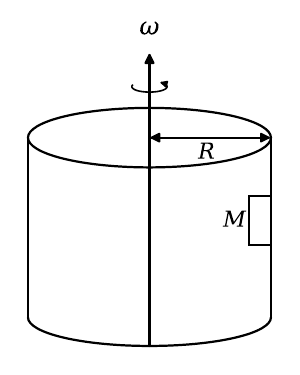
A large drum having radius $R$ is spinning around its axis with angular velocity $\omega$, as shown in figure. The minimum value of $\omega$ so that a body of mass $M$ remains stuck to the inner wall of the drum, taking the coefficient of friction between the drum surface and mass $M$ as $\mu$, is:
- A.$\sqrt{\frac{2g}{\mu R}}$
- B.$\sqrt{\frac{g}{2\mu R}}$
- C.$\sqrt{\frac{\mu g}{R}}$
- D.$\sqrt{\frac{g}{\mu R}}$
Show answer & solution
Correct answer: D – $\sqrt{\frac{g}{\mu R}}$
SolutionThe wall provides the normal force (centripetal): $N = M\omega^2R$. Friction must balance weight: $\mu N \ge Mg \Rightarrow \mu M\omega^2R \ge Mg \Rightarrow \omega \ge \sqrt{\frac{g}{\mu R}}$.
Question 3
Two cars A and B each of mass $10^3$ kg are moving on parallel tracks separated by a distance of 10 m, in same direction with speeds 72 km/h and 36 km/h. The magnitude of angular momentum of car A with respect to car B is ____ J·s.
- A.$3.6 \times 10^5$
- B.$10^5$
- C.$3 \times 10^5$
- D.$2 \times 10^5$
Show answer & solution
Correct answer: B – $10^5$
SolutionVelocity of A relative to B $= 20 - 10 = 10$ m/s, perpendicular distance between the tracks $= 10$ m. $L = m v_{rel} d = 10^3 \times 10 \times 10 = 10^5$ J·s.
Question 4
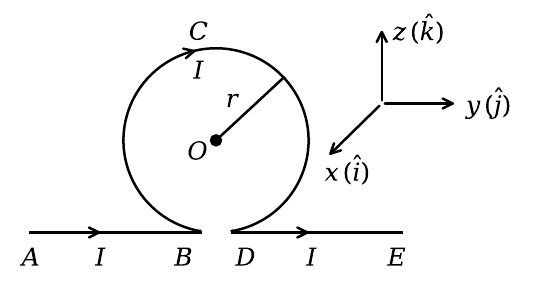
An infinitely long straight wire carrying current $I$ is bent in a planar shape as shown in the diagram. The radius of the circular part is $r$. The magnetic field at the centre O of the circular loop is:
- A.$-\frac{\mu_0 I}{2\pi r}(\pi + 1)\hat{i}$
- B.$-\frac{\mu_0 I}{2\pi r}(\pi - 1)\hat{i}$
- C.$\frac{\mu_0 I}{2\pi r}(\pi + 1)\hat{i}$
- D.$\frac{\mu_0 I}{2\pi r}(\pi - 1)\hat{i}$
Show answer & solution
Correct answer: B – $-\frac{\mu_0 I}{2\pi r}(\pi - 1)\hat{i}$
SolutionThe two straight parts AB and DE together act as one infinite wire at distance $r$ below O, carrying current along $+\hat{j}$. Its field at O is $\frac{\mu_0 I}{2\pi r}$ along $\hat{j} \times \hat{k} = +\hat{i}$. In the circle the current goes clockwise as seen in the figure (towards the right at the top C), so its field at O is $\frac{\mu_0 I}{2r}$ into the plane, i.e. along $-\hat{i}$. Net field $= \frac{\mu_0 I}{2\pi r}\hat{i} - \frac{\mu_0 I}{2r}\hat{i} = -\frac{\mu_0 I}{2\pi r}(\pi - 1)\hat{i}$.
Question 5
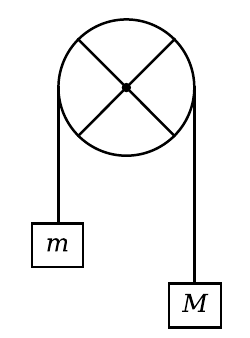
The pulley shown in figure is made using a thin rim and two rods of length equal to diameter of the rim. The rim and each rod have a mass of $M$. Two blocks of mass of $M$ and $m$ are attached to two ends of a light string passing over the pulley, which is hinged to rotate freely in vertical plane about its center. The magnitudes of the acceleration experienced by the blocks is ____ (assume no slipping of string on pulley).
- A.$\frac{(M-m)g}{\left[\left(\frac{8}{3}\right)M + m\right]}$
- B.$\frac{(M-m)g}{2M + m}$
- C.$\frac{(M-m)g}{M + m}$
- D.$\frac{(M-m)g}{\left[\left(\frac{13}{6}\right)M + m\right]}$
Show answer & solution
Correct answer: A – $\frac{(M-m)g}{\left[\left(\frac{8}{3}\right)M + m\right]}$
SolutionMoment of inertia of pulley: rim $= MR^2$, each rod (length $2R$ about its centre) $= \frac{M(2R)^2}{12} = \frac{MR^2}{3}$. Total $I = MR^2 + \frac{2MR^2}{3} = \frac{5MR^2}{3}$. For the system: $a = \frac{(M-m)g}{M + m + \frac{I}{R^2}} = \frac{(M-m)g}{M + m + \frac{5M}{3}} = \frac{(M-m)g}{\frac{8}{3}M + m}$.
Question 6
Given below are two statements:
Statement I: In a Young's double slit experiment, the angular separation of fringes will increase as the screen is moved away from the plane of the slits.
Statement II: In a Young's double slit experiment, the angular separation of fringes will increase when monochromatic source is replaced by another monochromatic source of higher wavelength.
In the light of the above statements, choose the correct answer from the options given below:
- A.Both Statement I and Statement II are true
- B.Statement I is true but Statement II is false
- C.Statement I is false but Statement II is true
- D.Both Statement I and Statement II are false
Show answer & solution
Correct answer: C – Statement I is false but Statement II is true
SolutionAngular fringe separation $\theta = \frac{\beta}{D} = \frac{\lambda}{d}$. It does not depend on $D$, so Statement I is false. It increases with $\lambda$, so Statement II is true.
Question 7
The energy of an electron in an orbit of the Bohr's atom is $-0.04E_0$ eV where $E_0$ is the ground state energy. If $L$ is the angular momentum of the electron in this orbit and $h$ is the Planck's constant, then $\frac{2\pi L}{h}$ is ____:
- A.6
- B.2
- C.5
- D.4
Show answer & solution
Correct answer: C – 5
Solution$E_n = \frac{E_0}{n^2}$ (taking magnitudes), so $\frac{1}{n^2} = 0.04 \Rightarrow n = 5$. By Bohr, $L = \frac{nh}{2\pi} \Rightarrow \frac{2\pi L}{h} = n = 5$.
60 more questions in this paper
Real exam window with timer, instant score, rank and topic-wise analysis.
Get GoMocks Pass (all papers)Already enrolled? Start now
Question 8
Two known resistances of $R\,\Omega$ and $2R\,\Omega$ and one unknown resistance $X\,\Omega$ are connected in a circuit as shown in the figure. If the equivalent resistance between points A and B in the circuit is $X\,\Omega$, then the value of $X$ is ____ $\Omega$.

- A.$2(\sqrt{3} - 1)R$
- B.$R$
- C.$(\sqrt{3} - 1)R$
- D.$(\sqrt{3} + 1)R$
Show answer & solution
Correct answer: C – $(\sqrt{3} - 1)R$
Solution$(2R + X)$ is in parallel with $R$: $X = \frac{R(2R + X)}{3R + X} \Rightarrow 3RX + X^2 = 2R^2 + RX \Rightarrow X^2 + 2RX - 2R^2 = 0$. Taking the positive root, $X = \frac{-2R + \sqrt{4R^2 + 8R^2}}{2} = (\sqrt{3} - 1)R$.
Question 9
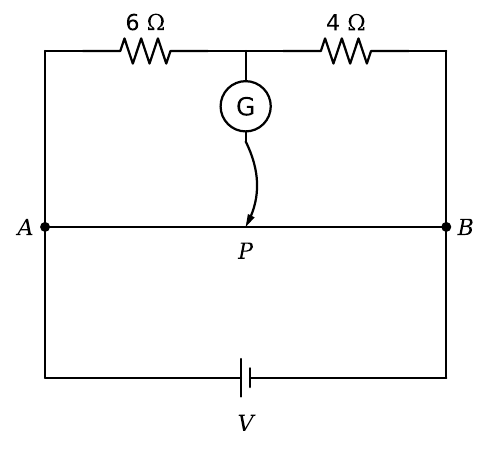
The total length of potentiometer wire AB is 50 cm in the arrangement as shown in the figure. If P is the point where the galvanometer shows zero reading then the length AP is ____ cm.
- A.25
- B.30
- C.15
- D.20
Show answer & solution
Correct answer: B – 30
SolutionThis is a balanced Wheatstone (metre-bridge type) arrangement: $\frac{6}{4} = \frac{AP}{PB} = \frac{AP}{50 - AP} \Rightarrow 4AP = 300 - 6AP \Rightarrow AP = 30$ cm.
Question 10
A battery with EMF $E$ and internal resistance $r$ is connected across a resistance $R$. The power consumption in $R$ will be maximum when:
- A.$R = \sqrt{2}\,r$
- B.$R = 2r$
- C.$R = \sqrt{2r}$
- D.$R = r$
Show answer & solution
Correct answer: D – $R = r$
Solution$P = \frac{E^2R}{(R + r)^2}$. Setting $\frac{dP}{dR} = 0$ gives $(R + r) - 2R = 0 \Rightarrow R = r$ (maximum power transfer theorem).
Question 11
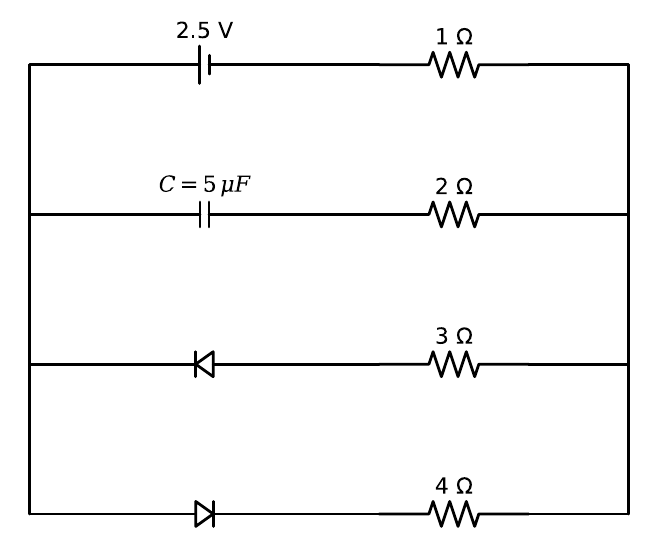
The charge stored by the capacitor C in the given circuit in the steady state is ____ $\mu$C.
- A.7.5
- B.5
- C.10
- D.12.5
Show answer & solution
Correct answer: C – 10
SolutionIn steady state no current flows through the capacitor branch. With the battery polarity shown, the diode in the $3\,\Omega$ branch is reverse biased (no current) and the diode in the $4\,\Omega$ branch is forward biased (ideal). Current $I = \frac{2.5}{1 + 4} = 0.5$ A. Voltage across the parallel branches $= 0.5 \times 4 = 2$ V, which is the capacitor voltage (no drop across $2\,\Omega$). $Q = CV = 5 \times 2 = 10\ \mu$C.
Question 12
The r.m.s. speed of oxygen molecules at 47 °C is equal to that of the hydrogen molecules kept at ____ °C. (Mass of oxygen molecule/mass of hydrogen molecule = 32/2)
- A.-100
- B.-253
- C.-20
- D.-235
Show answer & solution
Correct answer: B – -253
Solution$v_{rms} = \sqrt{\frac{3RT}{M}}$, equal speeds need $\frac{T}{M}$ equal: $T_H = 320 \times \frac{2}{32} = 20$ K $= 20 - 273 = -253$ °C.
Question 13
A river of width 200 m is flowing from west to east with a speed of 18 km/h. A boat, moving with speed of 36 km/h in still water, is made to travel one-round trip (bank to bank of the river). Minimum time taken by the boat for this journey and also the displacement along the river bank are ____ and ____ respectively.
- A.20 s and 100 m
- B.40 s and 100 m
- C.40 s and 200 m
- D.40 s and 0 m
Show answer & solution
Correct answer: C – 40 s and 200 m
SolutionRiver speed $= 5$ m/s, boat speed $= 10$ m/s. Minimum time is when the boat heads perpendicular to the flow: one way $= \frac{200}{10} = 20$ s, round trip $= 40$ s. During all this time the river carries the boat downstream: drift $= 5 \times 40 = 200$ m along the bank.
Question 14
The kinetic energy of a simple harmonic oscillator is oscillating with angular frequency of 176 rad/s. The frequency of this simple harmonic oscillator is ____ Hz. [take $\pi = \frac{22}{7}$]
- A.88
- B.14
- C.28
- D.176
Show answer & solution
Correct answer: B – 14
Solution$K = \frac{1}{2}m\omega^2A^2\cos^2\omega t$ oscillates at $2\omega$. So $2\omega = 176 \Rightarrow \omega = 88$ rad/s and $f = \frac{88}{2\pi} = \frac{88 \times 7}{44} = 14$ Hz.
Question 15
Consider two identical metallic spheres of radius $R$ each having charge $Q$ and mass $m$. Their centers have an initial separation of $4R$. Both the spheres are given an initial speed of $u$ towards each other. The minimum value of $u$, so that they can just touch each other is:
(Take $k = \frac{1}{4\pi\epsilon_0}$ and assume $kQ^2 > Gm^2$ where $G$ is the Gravitational constant)
- A.$\sqrt{\frac{kQ^2}{4mR}\left(1 + \frac{Gm^2}{kQ^2}\right)}$
- B.$\sqrt{\frac{kQ^2}{2mR}\left(1 - \frac{Gm^2}{2kQ^2}\right)}$
- C.$\sqrt{\frac{kQ^2}{2mR}\left(1 - \frac{Gm^2}{kQ^2}\right)}$
- D.$\sqrt{\frac{kQ^2}{4mR}\left(1 - \frac{Gm^2}{kQ^2}\right)}$
Show answer & solution
Correct answer: D – $\sqrt{\frac{kQ^2}{4mR}\left(1 - \frac{Gm^2}{kQ^2}\right)}$
SolutionNet interaction energy at separation $d$: $U = \frac{kQ^2 - Gm^2}{d}$. They just touch at $d = 2R$ with zero speed. Energy conservation: $2 \cdot \frac{1}{2}mu^2 = (kQ^2 - Gm^2)\left(\frac{1}{2R} - \frac{1}{4R}\right) = \frac{kQ^2 - Gm^2}{4R}$. So $u = \sqrt{\frac{kQ^2}{4mR}\left(1 - \frac{Gm^2}{kQ^2}\right)}$.
60 more questions in this paper
Real exam window with timer, instant score, rank and topic-wise analysis.
Get GoMocks Pass (all papers)Already enrolled? Start now
Paper details
Questions75
Time180 min
Marks300
Year2026
60 more questions in this paper
Real exam window with timer, instant score, rank and topic-wise analysis.
Get GoMocks Pass (all papers)Already enrolled? Start now
More JEE Mains papers
JEE Main 2026 - 28 Jan 2026 - 28 Jan Shift 2
JEE Main 2026 - 28 Jan 2026 - 28 Jan Shift 1
JEE Main 2026 - 24 Jan 2026 - 24 Jan Shift 2
JEE Main 2026 - 04 Apr 2026 - 4 Apr Shift 1
JEE Main 2026 - 02 Apr 2026 - 2 Apr Shift 2
JEE Main 2026 - 02 Apr 2026 - 2 Apr Shift 1
JEE Main 2026 - 01/24/26 - 24 Jan Shift 1
JEE Main 2026 - 01/23/26 - 23 Jan Shift 2
JEE Main 2026 - 01/23/26 - 23 Jan Shift 1
JEE Main 2026 - 01/22/26 - 22 Jan Shift 2
JEE Main 2026 - 01/22/26 - 22 Jan Shift 1
JEE Main 2026 - 01/21/26 - 21 Jan Shift 1
All JEE Mains previous year papers →