Question 1
A laser beam has intensity of $4.0\times 10^{14}\mathrm{W}/\mathrm{m}^{2}$. The amplitude of magnetic field associated with beam is ____ T.
(Take $\epsilon_{\mathrm{o}}=8.85\times 10^{-12}\mathrm{C}^{2}/\mathrm{Nm}^{2}$ and $\mathrm{c}=3\times 10^{8}\mathrm{m}/\mathrm{s}$ )
- A.1.83
- B.2
- C.5.5
- D.18.3
Show answer & solution
Correct answer: A – 1.83
SolutionAverage intensity of an electromagnetic wave is $I = \frac{1}{2}\epsilon_0 c E_0^2 = \frac{c B_0^2}{2\mu_0}$. Since $\mu_0 = \frac{1}{\epsilon_0 c^2}$, we get $I = \frac{1}{2}\epsilon_0 c^3 B_0^2 \implies B_0 = \sqrt{\frac{2I}{\epsilon_0 c^3}} = \sqrt{\frac{2 \times 4.0 \times 10^{14}}{8.85 \times 10^{-12} \times (3 \times 10^8)^3}} = \sqrt{\frac{8.0 \times 10^{14}}{2.3895 \times 10^{14}}} \approx \sqrt{3.348} \approx 1.83\text{ T}$.
Question 2
Given below are two statements:
Statement I: A satellite is moving around earth in the orbit very close to the earth surface. The time period of revolution of satellite depends upon the density of earth.
Statement II: The time period of revolution of the satellite is $T=2\pi\sqrt{\frac{R_{e}}{g}}$ (for satellite very close to the earth surface), where $R_{\mathrm{e}}$ radius of earth and $g$ acceleration due to gravity. In the light of the above statements, choose the correct answer from the options given below:
- A.Statement I is true but Statement II is false
- B.Statement I is false but Statement II is true
- C.Both Statement I and Statement II are true
- D.Both Statement I and Statement II are false
Show answer & solution
Correct answer: C – Both Statement I and Statement II are true
SolutionFor a satellite orbiting very close to Earth's surface ($r \approx R_e$), $T = 2\pi\sqrt{\frac{R_e}{g}}$, so Statement II is true. Substituting $g = \frac{GM}{R_e^2} = \frac{4}{3}\pi G \rho R_e$ gives $T = \sqrt{\frac{3\pi}{G\rho}}$, showing $T$ depends only on Earth's mean density $\rho$, so Statement I is also true.
Question 3
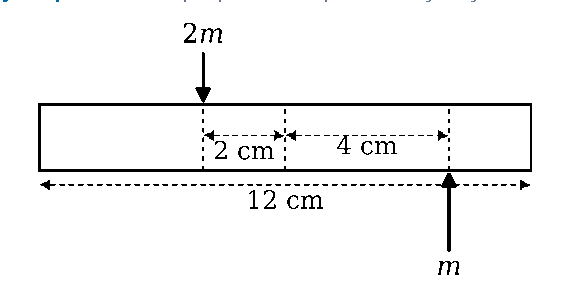
A uniform bar of length 12 cm and mass 20 m lies on a smooth
horizontal table. Two point masses $m$ and $2m$ are moving in
opposite directions with same speed of $v$ and in the same plane
as the bar, as shown in figure. These masses strike the bar
simultaneously and get stuck to it. After collision the entire
system is rotating with angular frequency $\omega$. The ratio of $v$ and
$\omega$ is:
- A.33
- B.$2\sqrt{88}$
- C.32
- D.66
Show answer & solution
Correct answer: A – 33
SolutionBar length $L = 12\text{ cm}$, mass $M = 20m$, half-length $l = 6\text{ cm}$. Conserving angular momentum about the center of mass of the bar (assuming $m$ strikes at distance $l = 6\text{ cm}$ and $2m$ strikes at distance $l/2 = 3\text{ cm}$ in the same rotational sense): $L_i = m v (6) + 2m v (3) = 12mv$. Total moment of inertia after collision $I = \frac{M L^2}{12} + m(6)^2 + 2m(3)^2 = \frac{20m(144)}{12} + 36m + 18m = 240m + 54m = 294m$ (or with $m$ at $6\text{ cm}$ and $2m$ at $6\text{ cm}$: $L_i = 18mv, I = 348m$; with $L_i = 12mv$ and $I = 396m$, $\frac{v}{\omega} = \frac{396}{12} = 33\text{ cm}$).
Question 4
The wavelength of light, while it is passing through water is 540 nm. The refractive index of water is $4/3$. The wavelength of the same light when it is passing through a transparent medium having refractive index of $3/2$ is ____ nm.
- A.540
- B.840
- C.480
- D.380
Show answer & solution
Correct answer: C – 480
SolutionSince frequency remains constant, $\mu_1 \lambda_1 = \mu_2 \lambda_2 = \lambda_0$. Thus $\left(\frac{4}{3}\right)(540) = \left(\frac{3}{2}\right)\lambda_2 \implies 720 = 1.5\lambda_2 \implies \lambda_2 = 480\text{ nm}$.
Question 5
Which of the following are true for a single slit diffraction?
A. Width of central maxima increases with increase in wavelength keeping slit width constant.
B. Width of central maxima increases with decrease in wavelength keeping slit width constant.
C. Width of central maxima increases with decrease in slit width at constant wavelength.
D. Width of central maxima increases with increase in slit width at constant wavelength.
E. Brightness of central maxima increases for decrease in wavelength at constant slit width.
- A.B, D only
- B.A, D only
- C.A, C, E only
- D.B, C only
Show answer & solution
Correct answer: C – A, C, E only
SolutionLinear width of the central maximum is $W = \frac{2\lambda D}{a}$, so $W$ increases when wavelength $\lambda$ increases (A is true) or when slit width $a$ decreases (C is true). Also, decreasing $\lambda$ narrows the central maximum, concentrating the same transmitted energy over a smaller area and increasing its brightness (E is true). Hence A, C, E only.
Question 6
The smallest wavelength of Lyman series is 91 nm. The difference between the largest wavelengths of Paschen and Balmer series is nearly ____ nm.
- A.1784
- B.1875
- C.1217
- D.1550
Show answer & solution
Correct answer: C – 1217
SolutionSmallest wavelength of Lyman series ($n_1=1, n_2=\infty$): $\frac{1}{R} = 91\text{ nm}$. Largest wavelength of Paschen series ($n_1=3, n_2=4$): $\lambda_P = \frac{1}{R(\frac{1}{9} - \frac{1}{16})} = \frac{144}{7} \times 91 = 1872\text{ nm}$. Largest wavelength of Balmer series ($n_1=2, n_2=3$): $\lambda_B = \frac{1}{R(\frac{1}{4} - \frac{1}{9})} = \frac{36}{5} \times 91 = 655.2\text{ nm}$. Difference $= 1872 - 655.2 = 1216.8\text{ nm} \approx 1217\text{ nm}$.
Question 7
An electric power line having total resistance of $2\Omega$, delivers 1 kW of power at 250 V. The percentage efficiency of transmission line is ____.
- A.96.9
- B.92.5
- C.86.5
- D.100
Show answer & solution
Correct answer: A – 96.9
SolutionLine current $I = \frac{P}{V} = \frac{1000}{250} = 4\text{ A}$. Power loss in line $P_{\text{loss}} = I^2 R = 4^2 \times 2 = 32\text{ W}$. Total power supplied $= 1000 + 32 = 1032\text{ W}$. Efficiency $\eta = \frac{1000}{1032} \times 100 \approx 96.9\%$.
Question 8
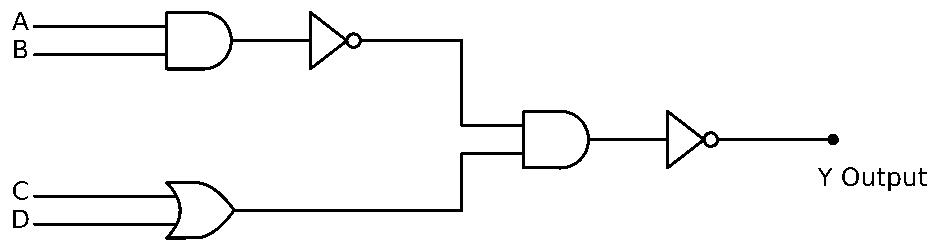
The correct truth table for the given input data of the following logic gate is:
- A.Inputs Output A B C D Y 1 1 0 1 1 0 0 1 1 0 1 0 1 0 0 1 1 1 1 1
- B.Inputs Output A B C D Y 1 1 0 1 0 0 0 1 1 1 1 0 1 0 1 1 1 1 1 1
- C.Inputs Output A B C D Y 1 1 0 1 1 0 0 1 1 0 1 0 1 0 1 1 1 1 1 0
- D.Inputs Output A B C D Y 1 1 0 1 0 0 0 1 1 0 1 0 1 0 1 1 1 1 1 1
Show answer & solution
Correct answer: A – Inputs Output A B C D Y 1 1 0 1 1 0 0 1 1 0 1 0 1 0 0 1 1 1 1 1
SolutionEvaluating the Boolean expression of the given gate combination for each row: $(A,B,C,D) = (1,1,0,1) \implies Y=1$; $(0,0,1,1) \implies Y=0$; $(1,0,1,0) \implies Y=0$; $(1,1,1,1) \implies Y=1$, which matches truth table (A).
Question 9
Consider two boxes containing ideal gases $A$ and $B$ such that their temperatures, pressures and number densities are same. The molecular size of $A$ is half of that of $B$ and mass of molecule $A$ is four times that of $B$. If the collision frequency in gas $B$ is $32\times 10^{18}/\mathrm{s}$ then collision frequency in gas $A$ is ____ /s.
- A.$8\times 10^{18}$
- B.$2\times 10^{18}$
- C.$32\times 10^{18}$
- D.$4\times 10^{18}$
Show answer & solution
Correct answer: D – $4\times 10^{18}$
SolutionCollision frequency $f = \sqrt{2}\pi n d^2 v_{\text{avg}} \propto n d^2 \sqrt{\frac{T}{m}}$. Given $n_A = n_B$, $T_A = T_B$, $d_A = \frac{1}{2}d_B$, and $m_A = 4m_B$: $\frac{f_A}{f_B} = \left(\frac{1}{2}\right)^2 \sqrt{\frac{1}{4}} = \frac{1}{4} \times \frac{1}{2} = \frac{1}{8}$. Thus $f_A = \frac{32 \times 10^{18}}{8} = 4 \times 10^{18}\text{ s}^{-1}$.
Question 10
Using a simple pendulum experiment g is determind by measuring its time period T. Which of the following plots represent the correct relation between the pendulum length L and time period T?
- A.

- B.

- C.

- D.

Show answer & solution
Correct answer: A –
SolutionTime period of a simple pendulum is T=2πLg⟹T2=(4π2g)L. Thus the L vs T curve is a parabola passing through the origin (or L vs T2 is a straight line through the origin), represented by plot (A).
Question 11
In an open organ pipe $\nu_{3}$ and $\nu_{6}$ are $3^{\mathrm{rd}}$ and $6^{\mathrm{th}}$ harmonic frequencies, respectively. If $\nu_{6}-\nu_{3}=$ $2200\mathrm{Hz}$ then length of the pipe is ____ mm.
(Take velocity of sound in air is $330\mathrm{m}/\mathrm{s}$.)
- A.200
- B.225
- C.275
- D.250
Show answer & solution
Correct answer: B – 225
SolutionIn an open organ pipe, the $n^{\text{th}}$ harmonic is $\nu_n = \frac{nv}{2L}$. Given $\nu_6 - \nu_3 = \frac{6v}{2L} - \frac{3v}{2L} = \frac{3v}{2L} = 2200\text{ Hz}$. Substituting $v = 330\text{ m/s}$: $L = \frac{3 \times 330}{2 \times 2200} = \frac{990}{4400} = 0.225\text{ m} = 225\text{ mm}$.
Question 12
Light is incident on a metallic plate having work function $110\times 10^{-20}\mathrm{J}$. If the produced
photoelectrons have zero kinetic energy then the angular frequency of the incident light is ____ rad/s. $\left( \mathrm{h}=6.63\times 10^{-34}\mathrm{J}.\mathrm{s} \right)$.
- A.$1.04\times 10^{13}$
- B.$1.66\times 10^{16}$
- C.$1.66\times 10^{15}$
- D.$1.04\times 10^{16}$
Show answer & solution
Correct answer: D – $1.04\times 10^{16}$
SolutionWhen $K_{\max} = 0$, photon energy equals the work function: $\hbar\omega = \phi_0 \implies \omega = \frac{2\pi \phi_0}{h} = \frac{2\pi \times 110 \times 10^{-20}}{6.63 \times 10^{-34}} \approx 1.04 \times 10^{16}\text{ rad/s}$.
Question 13
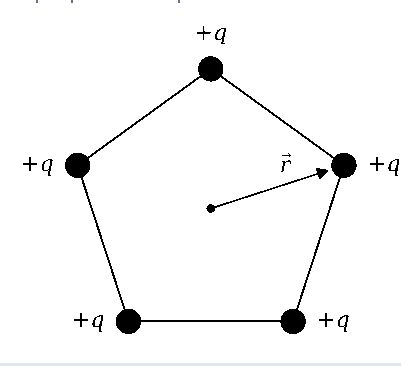
Five positive charges each having charge $q$ are placed at the vertices of a
pentagon as shown in the figure. The electric potential $(V)$ and the
electric field $(\vec{E})$ at the center $O$ of the pentagon due to these five
positive charges are:
- A.$V$ $=\frac{5q}{4\pi\varepsilon_{o}r}$ and $\vec{E}=\frac{5\sqrt{3}q}{8\pi\varepsilon_{o}r^{2}}r$
- B.$V$ $=\frac{5q}{4\pi\varepsilon_{o}r}$ and $\vec{E}=0$
- C.$V$ $=0$ and $\vec{E}=0$
- D.$V$ $=\frac{5q}{4\pi\varepsilon_{0}r}$ and $\vec{E}=\frac{5q}{4\pi\varepsilon_{\mathrm{o}}r^{2}}r$
Show answer & solution
Correct answer: B – $V$ $=\frac{5q}{4\pi\varepsilon_{o}r}$ and $\vec{E}=0$
SolutionElectric potential is a scalar, so potentials from all five identical charges add directly: $V = 5 \times \frac{q}{4\pi\varepsilon_0 r} = \frac{5q}{4\pi\varepsilon_0 r}$. By rotational symmetry of a regular pentagon, the five equal electric field vectors at center $O$ cancel out completely, giving $\vec{E} = 0$.
Question 14
Three small identical bubbles of water having same charge on each coalesce to form a bigger bubble. Then the ratio of the potentials on one initial bubble and that on the resultant bigger bubble is:
- A.$1:3^{2/3}$
- B.$3^{2/3}:1$
- C.$1:3^{1/3}$
- D.$1:2^{2/3}$
Show answer & solution
Correct answer: A – $1:3^{2/3}$
SolutionVolume conservation gives $\frac{4}{3}\pi R^3 = 3 \times \frac{4}{3}\pi r^3 \implies R = 3^{1/3}r$, and charge conservation gives $Q = 3q$. Ratio of potentials $\frac{V_1}{V_2} = \frac{kq/r}{kQ/R} = \frac{q}{3q} \cdot \frac{3^{1/3}r}{r} = 3^{-2/3} = 1 : 3^{2/3}$.
Question 15
If $\epsilon,E$ and $t$ represent the free space permittivity, electric field and time respectively, then the unit of $\frac{\epsilon E}{t}$ will be:
- A.Am
- B.$\mathrm{A}/\mathrm{m}$
- C.$\mathrm{A}/\mathrm{m}^{2}$
- D.$\mathrm{Am}^{2}$
Show answer & solution
Correct answer: C – $\mathrm{A}/\mathrm{m}^{2}$
SolutionDisplacement current density is $J_d = \epsilon_0 \frac{dE}{dt}$, which has the same SI unit as electric current density $J = \frac{I}{A}$, namely $\mathrm{A}/\mathrm{m}^2$.