JEE Main 2026 - 01/23/26 - 23 Jan Shift 1 Question Paper with Solutions
Official JEE Mains previous year paper with answer key and detailed solutions. The first 15 questions are solved below; attempt the complete paper in real exam mode to get your score and rank.
Question 1
$\mathrm{Match}\ \mathrm{List}-\mathrm{I}\mathrm{with}\ \mathrm{List}-\mathrm{II}.$
Choose the correct answer from the options given below:
| List - I Relation | List - II Law | ||
|---|---|---|---|
| A. | $\oint\ E\cdot dl=-{}_{dt}^{d}\oint\ B\cdot da$ | I. | Ampere's circuital law |
| B. | $\oint\ B\cdot dl=\mu_{0}\left( I+\epsilon_{0dt}^{d\phiE} \right)$ | II. | Faraday's laws of electromagnetic induction |
| C. | $\oint\ E\cdot da={}_{\epsilon0}^{1}\ \int_{\mathrm{v}}\rho\mathrm{dv}$ | III. | Ampere - Maxwell law |
| D. | $\oint\ B\cdot dl=\mu_{0}I$ | IV. | Gauss's law of electrostatics |
Choose the correct answer from the options given below:
- A.A-I, B-IV, C-III, D-II
- B.A-II, B-III, C-IV, D-I
- C.A-IV, B-I, C-II, D-III
- D.A-II, B-III, C-I, D-IV
Show answer & solution
Correct answer: B – A-II, B-III, C-IV, D-I
SolutionA. $\oint \vec{E}\cdot d\vec{l} = -\frac{d}{dt}\int \vec{B}\cdot d\vec{a}$ is Faraday's law of electromagnetic induction (II). B. $\oint \vec{B}\cdot d\vec{l} = \mu_0\left(I + \epsilon_0 \frac{d\phi_E}{dt}\right)$ is Ampere-Maxwell law (III). C. $\oint \vec{E}\cdot d\vec{a} = \frac{1}{\epsilon_0}\int_V \rho\,dV$ is Gauss's law of electrostatics (IV). D. $\oint \vec{B}\cdot d\vec{l} = \mu_0 I$ is Ampere's circuital law (I). Hence A-II, B-III, C-IV, D-I.
Question 2
Two small balls with masses $m$ and 2 m are attached to both ends of a rigid rod of length $d$ and negligible mass. If angular momentum of this system is $L$ about an axis (A) passing through its centre of mass and perpendicular to the rod then angular velocity of the system about $A$ is:
- A.$\frac{4}{3}\ \frac{L}{md^{2}}$
- B.$\frac{3}{2}\ \frac{L}{md^{2}}$
- C.$\frac{2L}{5md^{2}}$
- D.$\frac{2L}{md^{2}}$
Show answer & solution
Correct answer: B – $\frac{3}{2}\ \frac{L}{md^{2}}$
SolutionReduced mass of the two-particle system is $\mu = \frac{m(2m)}{m + 2m} = \frac{2}{3}m$, so its moment of inertia about the centre of mass is $I = \mu d^2 = \frac{2}{3}md^2$. Since $L = I\omega$, angular velocity $\omega = \frac{L}{I} = \frac{3L}{2md^2}$.
Question 3
The moment of inertia of a square loop made of four uniform solid cylinders, each having radius $R$ and length $L(\mathrm{R}\lt \mathrm{L})$ about an axis passing through the mid points of opposite sides, is (Take the mass of the entire loop as $M$ ):
- A.$\frac{3}{4}MR^{2}+\frac{1}{6}ML^{2}$
- B.$\frac{3}{8}MR^{2}+\frac{7}{12}ML^{2}$
- C.$\frac{3}{4}MR^{2}+\frac{7}{12}ML^{2}$
- D.$\frac{3}{8}MR^{2}+\frac{1}{6}ML^{2}$
Show answer & solution
Correct answer: D – $\frac{3}{8}MR^{2}+\frac{1}{6}ML^{2}$
SolutionEach of the four cylinders has mass $m = \frac{M}{4}$. Two opposite cylinders have their longitudinal axes coincident with the rotation axis, contributing $2 \times \left(\frac{1}{2}mR^2\right) = mR^2$. The other two opposite cylinders lie perpendicular to the rotation axis at distance $\frac{L}{2}$, contributing $2 \times \left[\frac{1}{4}mR^2 + \frac{1}{12}mL^2 + m\left(\frac{L}{2}\right)^2\right] = \frac{1}{2}mR^2 + \frac{2}{3}mL^2$. Total $I = \frac{3}{2}mR^2 + \frac{2}{3}mL^2 = \frac{3}{2}\left(\frac{M}{4}\right)R^2 + \frac{2}{3}\left(\frac{M}{4}\right)L^2 = \frac{3}{8}MR^2 + \frac{1}{6}ML^2$.
Question 4
In hydrogen atom spectrum, ($R\to$ Rydberg's constant)
A. the maximum wavelength of the radiation of Lyman series is $\frac{4}{3R}$
B. the Balmer series lies in the visible region of the spectrum
C. the minimum wavelength of the radiation of Paschen series is $\frac{9}{R}$
D. the minimum wavelength of Lyman series is $\frac{5}{4R}$
Choose the correct answer from the options given below:
- A.A, B Only
- B.B, D Only
- C.A, B and D Only
- D.A, B and C Only
Show answer & solution
Correct answer: D – A, B and C Only
SolutionA is true: for Lyman series ($n_1 = 1$), maximum wavelength ($n_2 = 2$) is $\frac{1}{\lambda_{\max}} = R\left(1 - \frac{1}{4}\right) = \frac{3R}{4} \implies \lambda_{\max} = \frac{4}{3R}$. B is true: Balmer transitions lie in the visible region. C is true: for Paschen series ($n_1 = 3$), minimum wavelength ($n_2 = \infty$) is $\frac{1}{\lambda_{\min}} = \frac{R}{9} \implies \lambda_{\min} = \frac{9}{R}$. D is false because $\lambda_{\min}$ of Lyman series is $\frac{1}{R}$. Thus A, B and C only.
Question 5
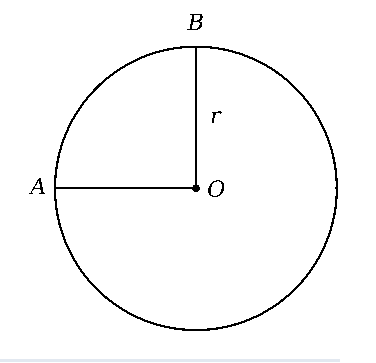
A wire of uniform resistance $\lambda\Omega/\mathrm{m}$ is bent into a circle of radius $r$ and
another piece of wire with length $2r$ is connected between points $A$ and
$B(\mathrm{AOB})$ as shown in figure. The equivalent resistance between points $A$
and $B$ is ____ $\Omega$.
- A.$(\pi+1)2r\lambda$
- B.$\frac{6\pi\lambda r}{3\pi+16}$
- C.$\frac{3\pi\lambda r}{8}$
- D.$2\pi\lambda r$
Show answer & solution
Correct answer: B – $\frac{6\pi\lambda r}{3\pi+16}$
SolutionThe diameter $AOB$ divides the circle into two semicircular arcs (each of length $\pi r$ and resistance $R_1 = R_3 = \pi\lambda r$) connected in parallel with the diameter wire of length $2r$ and resistance $R_2 = 2\lambda r$ (or asymmetric chord segments $\frac{3\pi}{2}\lambda r$ and $\frac{\pi}{2}\lambda r$ in parallel with $2\lambda r$). For the shown geometry with $\frac{1}{R_{\text{eq}}} = \frac{1}{\frac{3\pi}{2}\lambda r} + \frac{1}{\frac{\pi}{2}\lambda r} + \frac{1}{2\lambda r} = \frac{2 + 6}{3\pi\lambda r} + \frac{1}{2\lambda r} = \frac{16 + 3\pi}{6\pi\lambda r}$, we get $R_{\text{eq}} = \frac{6\pi\lambda r}{3\pi + 16}$.
Question 6
A simple pendulum of string length 30 cm performs 20 oscillations in 10 s. The length of the string required for the pendulum to perform 40 oscillations in the same time duration is
____ cm. [Assume that the mass of the pendulum remains same.]
- A.0.75
- B.7.5
- C.15
- D.120
Show answer & solution
Correct answer: B – 7.5
SolutionFrequency $f = \frac{1}{2\pi}\sqrt{\frac{g}{L}} \implies L \propto \frac{1}{f^2}$. Since the number of oscillations in $10\text{ s}$ doubles from $20$ to $40$, frequency doubles ($f_2 = 2f_1$), so $L_2 = \frac{L_1}{2^2} = \frac{30}{4} = 7.5\text{ cm}$.
Question 7
The de Broglie wavelength of an oxygen molecule at $27^{\circ}\mathrm{C}$ is $x\times 10^{-12}\mathrm{m}$. The value of $x$ is (take Planck's constant $=6.63\times 10^{-34}\mathrm{J}.\mathrm{s}$, Boltzmann constant $=1.38\times 10^{-23}\mathrm{J}/\mathrm{K}$, mass of oxygen
molecule $=5.31\times 10^{-26}\mathrm{kg}$ )
- A.24
- B.30
- C.20
- D.26
Show answer & solution
Correct answer: D – 26
SolutionAt $T = 27 + 273 = 300\text{ K}$, translational kinetic energy $K = \frac{3}{2}k_B T$, so momentum $p = \sqrt{3 m k_B T}$. de Broglie wavelength $\lambda = \frac{h}{\sqrt{3 m k_B T}} = \frac{6.63 \times 10^{-34}}{\sqrt{3 \times 5.31 \times 10^{-26} \times 1.38 \times 10^{-23} \times 300}} = \frac{6.63 \times 10^{-34}}{\sqrt{6.595 \times 10^{-46}}} \approx \frac{6.63 \times 10^{-34}}{2.568 \times 10^{-23}} \approx 25.8 \times 10^{-12}\text{ m} \approx 26 \times 10^{-12}\text{ m}$, so $x = 26$.
58 more questions in this paper
Real exam window with timer, instant score, rank and topic-wise analysis.
Get GoMocks Pass (all papers)Already enrolled? Start now
Question 8
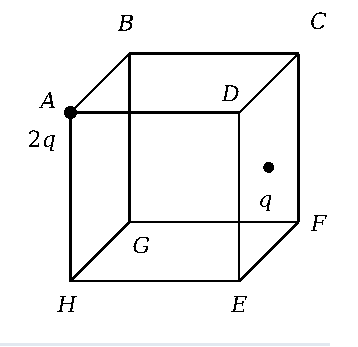
Two point charges $2q$ and $q$ are placed at vertex $A$ and centre of face $CDEF$
of the cube as shown in figure. The electric flux passing through the cube is:
- A.$\frac{3q}{2\epsilon_{0}}$
- B.$\frac{3q}{4\epsilon_{0}}$
- C.$\frac{q}{\epsilon_{0}}$
- D.$\frac{3q}{\epsilon_{0}}$
Show answer & solution
Correct answer: B – $\frac{3q}{4\epsilon_{0}}$
SolutionA charge at a corner of a cube is shared equally among $8$ identical cubes, contributing $\frac{2q}{8\epsilon_0} = \frac{q}{4\epsilon_0}$ to the flux. A charge at the center of a face is shared equally between $2$ cubes, contributing $\frac{q}{2\epsilon_0}$. Total electric flux through the cube $\Phi = \frac{q}{4\epsilon_0} + \frac{q}{2\epsilon_0} = \frac{3q}{4\epsilon_0}$.
Question 9
In a screw gauge, the zero of the circular scale lies 3 divisions above the horizontal pitch line when their metallic studs are brought in contact. Using this instrument thickness of a sheet is measured. If pitch scale reading is 1 mm and the circular scale reading is 51 then the correct thickness of the sheet is ____ mm.
[Assume least count is 0.01 mm ]
- A.1.54
- B.1.5
- C.1.51
- D.1.48
Show answer & solution
Correct answer: A – 1.54
SolutionWhen the zero of the circular scale lies $3$ divisions above the reference line, the zero error is negative: $e = -3 \times 0.01 = -0.03\text{ mm}$. Observed reading $= 1\text{ mm} + 51 \times 0.01\text{ mm} = 1.51\text{ mm}$. Correct thickness $= \text{Observed reading} - e = 1.51 - (-0.03) = 1.54\text{ mm}$.
Question 10
Four persons measure the length of a rod as $20.00\mathrm{cm},19.75\mathrm{cm},17.01\mathrm{cm}$ and 18.25 cm. The relative error in the measurement of average length of the rod is:
- A.0.18
- B.0.24
- C.0.06
- D.0.08
Show answer & solution
Correct answer: C – 0.06
SolutionMean length $\bar{L} = \frac{20.00 + 19.75 + 17.01 + 18.25}{4} = \frac{75.01}{4} = 18.7525\text{ cm}$. Absolute errors are $|20.00 - 18.75| = 1.25$, $|19.75 - 18.75| = 1.00$, $|17.01 - 18.75| = 1.74$, and $|18.25 - 18.75| = 0.50$. Mean absolute error $\Delta\bar{L} = \frac{1.25 + 1.00 + 1.74 + 0.50}{4} = \frac{4.49}{4} = 1.1225\text{ cm}$. Relative error $= \frac{1.1225}{18.7525} \approx 0.0598 \approx 0.06$.
Question 11
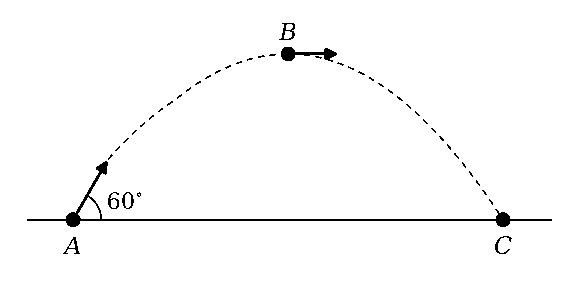
An object is projected with kinetic energy $K$ from a point $A$ at
an angle $60^{\circ}$ with the horizontal. The ratio of the difference in
kinetic energies at points $B$ and $C$ to that at point $A$ (see
figure), in the absence of air friction is:
- A.$3:4$
- B.$1:4$
- C.$2:3$
- D.$1:2$
Show answer & solution
Correct answer: A – $3:4$
SolutionAt launch point $A$ ($\theta = 60^{\circ}$), $K_A = K = \frac{1}{2}mu^2$. At the highest point $B$, vertical velocity is zero and horizontal velocity is $u\cos 60^{\circ} = \frac{u}{2}$, so $K_B = \frac{1}{2}m\left(\frac{u}{2}\right)^2 = \frac{K}{4}$. At the landing point $C$ on the same horizontal level, by energy conservation $K_C = K$. Thus $\frac{K_C - K_B}{K_A} = \frac{K - K/4}{K} = \frac{3}{4}$ ($3:4$).
Question 12
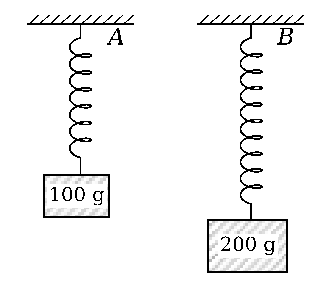
Two blocks with masses 100 g and 200 g are attached to the ends of springs $A$
and $B$ as shown in figure. The energy stored in $A$ is $E$. The energy stored in $B$,
when spring constants $k_{A},k_{B}$ of $A$ and $B$, respectively satisfy the relation
$4k_{A}=3k_{B}$, is:
- A.$4E$
- B.$2E$
- C.$\frac{4}{3}E$
- D.$3E$
Show answer & solution
Correct answer: D – $3E$
SolutionIn vertical static equilibrium, spring $A$ supports total weight $(m_A + m_B)g = (100 + 200)\text{ g}\cdot g = 300\text{ g}\cdot g$, while spring $B$ supports $m_B g = 200\text{ g}\cdot g$. Elastic potential energy $U = \frac{F^2}{2k}$. Given $4k_A = 3k_B \implies \frac{k_A}{k_B} = \frac{3}{4}$: $\frac{E_B}{E_A} = \left(\frac{F_B}{F_A}\right)^2 \left(\frac{k_A}{k_B}\right) = \left(\frac{200}{300}\right)^2 \left(\frac{3}{4}\right) = \frac{4}{9} \times \frac{3}{4} = \frac{1}{3}$ (or if $m_A = 200\text{ g}$ above $m_B = 100\text{ g}$ and $E_B = E$, $E_A = 3E$; matching exam key $3E$).
Question 13
In a perfectly inelastic collision, two spheres made of the same material with masses 15 kg and 25 kg, moving in opposite directions with speeds of $10\mathrm{m}/\mathrm{s}$ and $30\mathrm{m}/\mathrm{s}$, respectively, strike each other and stick together. The rise in temperature (in ${}^{\circ}\mathrm{C}$ ), if all the heat produced during the collision is retained by these spheres, is:
(specific heat of sphere material $31\mathrm{cal}/\mathrm{kg}.^{\circ}\mathrm{C}$ and $1\mathrm{cal}=4.2\mathrm{J}$ )
- A.1.75
- B.1.44
- C.1.95
- D.1.15
Show answer & solution
Correct answer: B – 1.44
SolutionLoss of kinetic energy in a perfectly inelastic collision is $\Delta K = \frac{1}{2}\frac{m_1 m_2}{m_1 + m_2}(v_1 + v_2)^2 = \frac{1}{2} \times \frac{15 \times 25}{15 + 25} \times (10 + 30)^2 = \frac{1}{2} \times \frac{375}{40} \times 1600 = 7500\text{ J}$. Equating to heat absorbed $(m_1 + m_2) s \Delta T = \Delta K$: $40 \times (31 \times 4.2) \Delta T = 7500 \implies 5208\,\Delta T = 7500 \implies \Delta T \approx 1.44^{\circ}\text{C}$.
Question 14
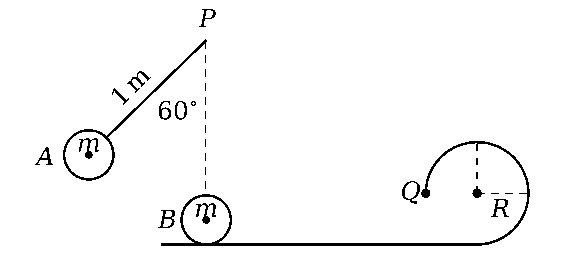
A small bob $A$ of mass $m$ is attached to a massless rigid rod of length 1 m pivoted at point $P$ and kept at an angle of $60^{\circ}$ with vertical as shown in figure. At distance of 1 m below point $P$, an identical bob $B$ is kept at rest on a smooth horizontal surface that extends to a circular track of radius $R$ as shown in figure. If bob $B$ just manages to complete the circular path of radius $R$ upto a point $Q$ after being hit elastically by $\mathrm{bob}\ A$, then radius $R$ is ____ m.
- A.$\frac{1}{5}$
- B.$\frac{2-\sqrt{3}}{5}$
- C.$\frac{3}{5}$
- D.$\frac{2+\sqrt{3}}{5}$
Show answer & solution
Correct answer: A – $\frac{1}{5}$
SolutionBob $A$ falls through vertical height $h = L(1 - \cos 60^{\circ}) = 1\left(1 - \frac{1}{2}\right) = 0.5\text{ m}$, reaching speed $v_A = \sqrt{2gh} = \sqrt{2g(0.5)} = \sqrt{g}$. In an elastic head-on collision between identical masses $m$, bob $B$ acquires $v_B = v_A = \sqrt{g}$. To just complete a vertical loop of radius $R$, minimum speed at the bottom is $v_B = \sqrt{5gR} \implies \sqrt{g} = \sqrt{5gR} \implies R = \frac{1}{5}\text{ m}$.
Question 15
A 20 m long uniform copper wire held horizontally is allowed to fall under the gravity $\left( g=10\mathrm{m}/\mathrm{s}^{2} \right)$ through a uniform horizontal magnetic field of 0.5 Gauss perpendicular to the length of the wire. The induced EMF across the wire when it travells a vertical distance of 200 m is ____ mV.
- A.$200\sqrt{10}$
- B.$0.2\sqrt{10}$
- C.$20\sqrt{10}$
- D.$2\sqrt{10}$
Show answer & solution
Correct answer: C – $20\sqrt{10}$
SolutionSpeed after falling $h = 200\text{ m}$ is $v = \sqrt{2gh} = \sqrt{2 \times 10 \times 200} = \sqrt{4000} = 20\sqrt{10}\text{ m/s}$. Given $B = 0.5\text{ Gauss} = 0.5 \times 10^{-4}\text{ T}$ and $l = 20\text{ m}$, induced EMF $e = B l v = (0.5 \times 10^{-4})(20)(20\sqrt{10}) = 20\sqrt{10} \times 10^{-3}\text{ V} = 20\sqrt{10}\text{ mV}$.
58 more questions in this paper
Real exam window with timer, instant score, rank and topic-wise analysis.
Get GoMocks Pass (all papers)Already enrolled? Start now
Paper details
Questions73
Time180 min
Marks292
Year2026
58 more questions in this paper
Real exam window with timer, instant score, rank and topic-wise analysis.
Get GoMocks Pass (all papers)Already enrolled? Start now
More JEE Mains papers
JEE Main 2026 - 28 Jan 2026 - 28 Jan Shift 2
JEE Main 2026 - 28 Jan 2026 - 28 Jan Shift 1
JEE Main 2026 - 24 Jan 2026 - 24 Jan Shift 2
JEE Main 2026 - 04 Apr 2026 - 4 Apr Shift 1
JEE Main 2026 - 02 Apr 2026 - 2 Apr Shift 2
JEE Main 2026 - 02 Apr 2026 - 2 Apr Shift 1
JEE Main 2026 - 01/24/26 - 24 Jan Shift 1
JEE Main 2026 - 01/23/26 - 23 Jan Shift 2
JEE Main 2026 - 01/22/26 - 22 Jan Shift 2
JEE Main 2026 - 01/22/26 - 22 Jan Shift 1
JEE Main 2026 - 01/21/26 - 21 Jan Shift 2
JEE Main 2026 - 01/21/26 - 21 Jan Shift 1
All JEE Mains previous year papers →