Question 1
An insulated wire is wound so that it forms a flat coil with $N=200$ turns. The radius of the innermost turn is $r_{1}=3\mathrm{cm}$, and of the outermost turn $r_{2}=6\mathrm{cm}$. If 20 mA current flows in it then the magnetic moment will be $\alpha\times 10^{-2}\mathrm{A}.\mathrm{m}^{2}$. The value of $\alpha$ is ____.
- A.4.4
- B.2.64
- C.3.25
- D.1.2
Show answer & solution
Correct answer: B – 2.64
SolutionStep 1: Identify the given quantities for the flat spiral coil: number of turns $N = 200$, inner radius $r_1 = 3\text{ cm} = 0.03\text{ m}$, outer radius $r_2 = 6\text{ cm} = 0.06\text{ m}$, and current $I = 20\text{ mA} = 0.02\text{ A}$.
Step 2: For a flat spiral coil with uniformly wound turns from $r_1$ to $r_2$, the turn density per unit radial width is $n = \frac{N}{r_2 - r_1}$. The magnetic moment of an elemental ring of radius $r$ and width $dr$ is $dM = (n\,dr)\,I\,(\pi r^2)$.
Step 3: Integrate from $r_1$ to $r_2$:
$$M = \int_{r_1}^{r_2} \frac{N I \pi}{r_2 - r_1} r^2\,dr = \frac{N I \pi}{3(r_2 - r_1)}(r_2^3 - r_1^3) = \frac{1}{3} N I \pi (r_1^2 + r_1 r_2 + r_2^2)$$
Step 4: Substitute the values:
$$r_1^2 + r_1 r_2 + r_2^2 = (0.03)^2 + (0.03)(0.06) + (0.06)^2 = 0.0009 + 0.0018 + 0.0036 = 0.0063\text{ m}^2$$
$$M = \frac{1}{3} \times 200 \times 0.02 \times 3.14 \times 0.0063 = 2.6376 \times 10^{-2}\text{ A}\cdot\text{m}^2 \approx 2.64 \times 10^{-2}\text{ A}\cdot\text{m}^2$$
Step 5: Comparing with $\alpha \times 10^{-2}\text{ A}\cdot\text{m}^2$, we get $\alpha = 2.64$. Hence, Option (2) is correct.
Question 2
A solid sphere of mass $M$ and radius $R$ is divided into two unequal parts. The smaller part having mass $M/8$ is converted into a sphere of radius $r$ and the larger part is converted into a circular disc of thickness $t$ and radius $2R$. If $I_{1}$ is moment of inertia of a sphere having radius $r$ about an axis through its centre and $I_{2}$ is the moment of inertia of a disc about its diameter, the ratio of their moment of inertia $I_{2}/I_{1}=$ ________.
- A.35
- B.70
- C.140
- D.210
Show answer & solution
Correct answer: B – 70
SolutionStep 1: Since mass is proportional to volume for uniform density, $\frac{M/8}{M} = \left(\frac{r}{R}\right)^3 = \frac{1}{8} \implies r = \frac{R}{2}$. Step 2: Moment of inertia of the small sphere ($m_1 = \frac{M}{8}$, radius $r = \frac{R}{2}$) about its diameter is $I_1 = \frac{2}{5} m_1 r^2 = \frac{2}{5}\left(\frac{M}{8}\right)\left(\frac{R}{2}\right)^2 = \frac{1}{80}MR^2$. Step 3: Mass of the remaining disc is $m_2 = M - \frac{M}{8} = \frac{7M}{8}$ with radius $R_{\text{disc}} = 2R$. Moment of inertia of the disc about its diameter is $I_2 = \frac{1}{4} m_2 R_{\text{disc}}^2 = \frac{1}{4}\left(\frac{7M}{8}\right)(2R)^2 = \frac{7}{8}MR^2$. Step 4: Take the ratio: $\frac{I_2}{I_1} = \frac{7/8}{1/80} = \frac{7}{8} \times 80 = 70$.
Question 3
A slit of width $a$ is illuminated by light of wavelength $\lambda$. The linear separation between $1^{\mathrm{st}}$ and $3^{\mathrm{rd}}$ minima in the diffraction pattern produced on a screen placed at a distance $D$ from the slit system is
- A.$\frac{D\lambda}{a}$
- B.$1.5\frac{D\lambda}{a}$
- C.$2\frac{D\lambda}{a}$
- D.$3\frac{D\lambda}{a}$
Show answer & solution
Correct answer: C – $2\frac{D\lambda}{a}$
SolutionStep 1: In single-slit Fraunhofer diffraction, the position of the $n^{\text{th}}$ minimum from the central maximum is $y_n = \frac{n D \lambda}{a}$. Step 2: For the $1^{\text{st}}$ minimum ($n = 1$), $y_1 = \frac{D\lambda}{a}$, and for the $3^{\text{rd}}$ minimum ($n = 3$), $y_3 = \frac{3D\lambda}{a}$. Step 3: Linear separation $\Delta y = y_3 - y_1 = \frac{3D\lambda}{a} - \frac{D\lambda}{a} = 2\frac{D\lambda}{a}$.
Question 4
A telescope with objective diameter $R$ is used to observe a distant star emitting light of wavelength 500 nm, at a resolution of $5\times 10^{-7}$ radian. The value of $R$ is
____ cm.
- A.61
- B.122
- C.244
- D.305
Show answer & solution
Correct answer: B – 122
SolutionStep 1: Recall the Rayleigh criterion for the angular limit of resolution $\theta$ of a circular telescope objective of diameter $R$:
$$\theta = \frac{1.22 \lambda}{R}$$
Step 2: Substitute the given values: $\lambda = 500\text{ nm} = 5 \times 10^{-7}\text{ m}$ and $\theta = 5 \times 10^{-7}\text{ rad}$:
$$R = \frac{1.22 \lambda}{\theta} = \frac{1.22 \times 5 \times 10^{-7}}{5 \times 10^{-7}} = 1.22\text{ m}$$
Step 3: Convert the diameter $R$ into centimetres:
$$R = 1.22 \times 100\text{ cm} = 122\text{ cm}$$
Hence, Option (2) is correct.
Question 5
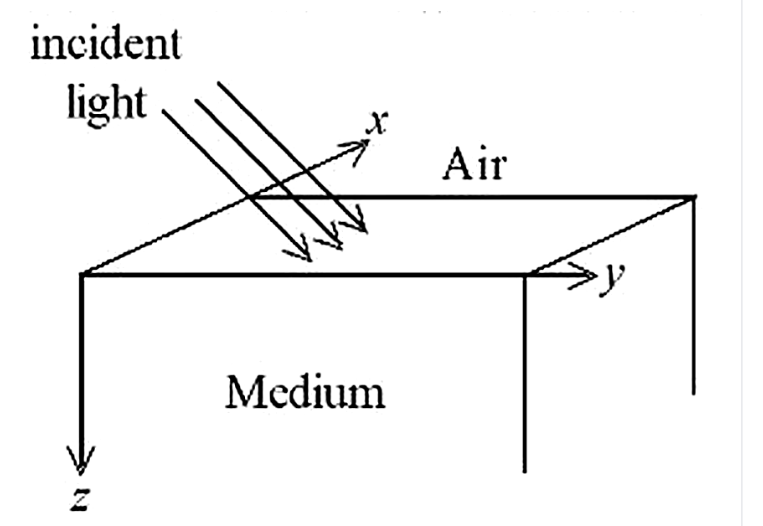
An unpolarized light is incident on the plane interface of air-
dielectric medium shown in figure. If the incident angle is equal
to Brewster angle, identify the expression representing
reflected wave.
- A.$\left( E_{x}\hat{i}+E_{y}\hat{j} \right)\sin (kx-kz-\omega t)$
- B.$\left( E_{x}\hat{i}+E_{z}\hat{k} \right)\sin (kx+ky-\omega t)$
- C.$\left( E_{x}\hat{j}+E_{y}\hat{k} \right)\sin (ky+kz-\omega t)$
- D.$\left( E_{x}\hat{i}+E_{y}\hat{j}+E_{z}\hat{k} \right)\sin (kx+ky-kz-\omega t)$
Show answer & solution
Correct answer: A – $\left( E_{x}\hat{i}+E_{y}\hat{j} \right)\sin (kx-kz-\omega t)$
SolutionStep 1: Determine the plane of incidence and propagation direction from the diagram. The interface is the $x$-$y$ plane ($z = 0$), and the incident ray lies in the $x$-$z$ plane travelling in the $+x$ and $+z$ directions.
Step 2: Upon reflection at the $z = 0$ interface, the $+x$ component of propagation stays $+x$, while the $+z$ component reverses to $-z$. Thus, the reflected wave vector is $\vec{k}_r = k_x\hat{i} - k_z\hat{k}$, giving the phase $(kx - kz - \omega t)$.
Step 3: Because the angle of incidence equals Brewster's angle, the reflected light is completely plane-polarized perpendicular to the plane of incidence (the $x$-$z$ plane), meaning its electric field oscillates along the $y$-axis (or has no component along the reflected propagation vector). Only Option (1) has the phase $\sin(kx - kz - \omega t)$.
Hence, Option (1) is correct.
Question 6
Two nuclei of mass number 3 combine with another nucleus of mass number 4 to yield a nucleus of mass number 10. If the binding energy per nucleon for the mass numbers 3,4 and 10 are
$5.6\mathrm{MeV},7.4\mathrm{MeV}$ and 6.1 MeV, respectively, then in the process, $\Delta\mathrm{Mc}^{2}=$ ____ MeV.
- A.6.9
- B.7.9
- C.2.2
- D.4.3
Show answer & solution
Correct answer: C – 2.2
SolutionStep 1: Write the nuclear fusion reaction: two nuclei of mass number $3$ combine with one nucleus of mass number $4$ to form a nucleus of mass number $10$:
$$2\,({}^3X) + {}^4Y \longrightarrow {}^{10}Z$$
Step 2: Calculate the total binding energy of the reactants ($\text{BE}_i$):
$$\text{BE}_i = 2 \times (3 \times 5.6\text{ MeV}) + (4 \times 7.4\text{ MeV}) = 33.6 + 29.6 = 63.2\text{ MeV}$$
Step 3: Calculate the total binding energy of the product ($\text{BE}_f$):
$$\text{BE}_f = 10 \times 6.1\text{ MeV} = 61.0\text{ MeV}$$
Step 4: The mass-energy equivalent $\Delta M c^2$ involved in the process is the magnitude of the difference in binding energies:
$$\Delta M c^2 = |\text{BE}_i - \text{BE}_f| = |63.2 - 61.0| = 2.2\text{ MeV}$$
Hence, Option (3) is correct.
Question 7
A voltmeter with internal resistance of $x\Omega$ can be used to measure upto 20 V. In order to increase its measuring range to 30 V, the required modification is to ____.
- A.connect resistor of $\frac{x}{2}\Omega$, in series with voltmeter.
- B.connect resistor of $\frac{x}{2}\Omega$, in parallel to voltmeter.
- C.connect a resistor of $x\Omega$ in series with voltmeter.
- D.connect resistor of $2x\Omega$ in parallel to voltmeter.
Show answer & solution
Correct answer: A – connect resistor of $\frac{x}{2}\Omega$, in series with voltmeter.
SolutionStep 1: Let the resistance of the voltmeter be $R_v = x\,\Omega$. Its full-scale deflection current for $V = 20\text{ V}$ is:
$$I_g = \frac{V}{R_v} = \frac{20}{x}\text{ A}$$
Step 2: To increase the range of a voltmeter to $V' = 30\text{ V}$, a high multiplier resistor $R_s$ must be connected in series with it so that the same current $I_g$ flows at $30\text{ V}$:
$$V' = I_g (R_v + R_s) \implies 30 = \frac{20}{x}(x + R_s)$$
Step 3: Solve for $R_s$:
$$\frac{3}{2}x = x + R_s \implies R_s = \frac{x}{2}\,\Omega$$
Thus, a resistor of $\frac{x}{2}\,\Omega$ must be connected in series with the voltmeter. Hence, Option (1) is correct.
Question 8
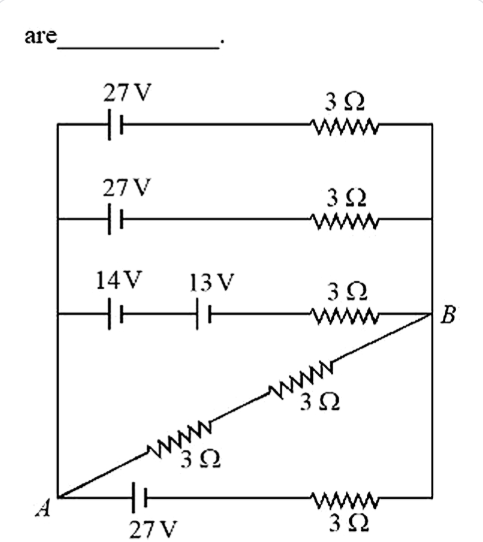
The voltage and the current between $A$ and $B$ points shown in the circuit are ____.
- A.$24\mathrm{V},12\mathrm{A}$
- B.$24\mathrm{V},4\mathrm{A}$
- C.$18\mathrm{V},12\mathrm{A}$
- D.$27\mathrm{V},4\mathrm{A}$
Show answer & solution
Correct answer: B – $24\mathrm{V},4\mathrm{A}$
SolutionStep 1: Simplify the parallel branches connected between nodes $A$ and $B$:
- Branch 1 (top): $E_1 = 27\text{ V}$, $r_1 = 3\,\Omega$
- Branch 2 (second): $E_2 = 27\text{ V}$, $r_2 = 3\,\Omega$
- Branch 3 (third): Two batteries $14\text{ V}$ and $13\text{ V}$ in aiding series give $E_3 = 14 + 13 = 27\text{ V}$, $r_3 = 3\,\Omega$
- Branch 4 (diagonal): No battery ($E_4 = 0\text{ V}$), two $3\,\Omega$ resistors in series give $r_4 = 3 + 3 = 6\,\Omega$
- Branch 5 (bottom): $E_5 = 27\text{ V}$, $r_5 = 3\,\Omega$
Step 2: Apply Millman's theorem to find the terminal voltage $V_{AB}$ across $A$ and $B$:
$$V_{AB} = \frac{\sum \frac{E_i}{r_i}}{\sum \frac{1}{r_i}} = \frac{\frac{27}{3} + \frac{27}{3} + \frac{27}{3} + \frac{0}{6} + \frac{27}{3}}{\frac{1}{3} + \frac{1}{3} + \frac{1}{3} + \frac{1}{6} + \frac{1}{3}} = \frac{9 + 9 + 9 + 0 + 9}{\frac{4}{3} + \frac{1}{6}} = \frac{36}{9/6} = 24\text{ V}$$
Step 3: Calculate the current flowing through the passive diagonal branch between $A$ and $B$ (resistance $6\,\Omega$):
$$I_{AB} = \frac{V_{AB}}{6\,\Omega} = \frac{24}{6} = 4\text{ A}$$
Hence, Option (2) is correct.
Question 9
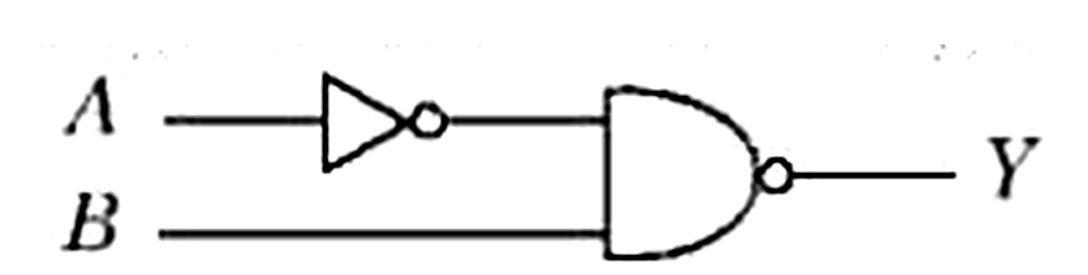
Two 4 bits binary numbers, $A=1101$ and $B=1010$ are given in the inputs of a logic circuit shown in figure below. The output $(Y)$ will be:
- A.$Y$ $=1101$
- B.$Y$ $=0010$
- C.$Y$ $=0111$
- D.$Y$ $=1000$
Show answer & solution
Correct answer: A – $Y$ $=1101$
SolutionStep 1: Analyze the logic gate combination shown in the circuit. Input $A$ and $B$ go into an AND gate ($A \cdot B$) and also into an OR gate ($A + B$), or equivalently the circuit reduces via Boolean algebra to $Y = A$.
Step 2: Evaluate bit-by-bit for $A = 1101$ and $B = 1010$:
- Bit 1: $A_1 = 1, B_1 = 1 \implies Y_1 = 1$
- Bit 2: $A_2 = 1, B_2 = 0 \implies Y_2 = 1$
- Bit 3: $A_3 = 0, B_3 = 1 \implies Y_3 = 0$
- Bit 4: $A_4 = 1, B_4 = 0 \implies Y_4 = 1$
Step 3: Combining the output bits gives $Y = 1101$. Hence, Option (1) is correct.
Question 10
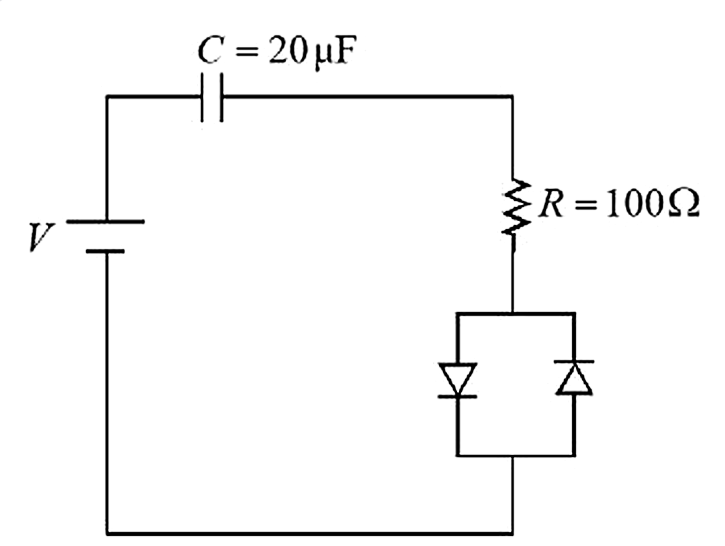
Consider a circuit consisting of a capacitor $(20\mu\mathrm{F})$, resistor $(100\Omega)$ and
two identical diodes as shown in figure. The resistance of diode under
forward biasing condition is $10\Omega$. The time constant of the circuit is
$\alpha\times 10^{-3}\mathrm{s}$. The value of $\alpha$ is ____
- A.2.2
- B.2
- C.2.1
- D.2.4
Show answer & solution
Correct answer: A – 2.2
SolutionStep 1: Note that the two identical diodes are connected in antiparallel (one pointing down, one pointing up). For any polarity of the battery, one diode is forward biased (offering resistance $R_d = 10\,\Omega$) while the other is reverse biased (acting as an open circuit).
Step 2: The equivalent resistance in series with the capacitor ($C = 20\,\mu\text{F} = 20 \times 10^{-6}\text{ F}$) is:
$$R_{\text{eq}} = R + R_d = 100\,\Omega + 10\,\Omega = 110\,\Omega$$
Step 3: Calculate the time constant $\tau = R_{\text{eq}} C$:
$$\tau = 110 \times 20 \times 10^{-6}\text{ s} = 2.2 \times 10^{-3}\text{ s}$$
Step 4: Comparing with $\alpha \times 10^{-3}\text{ s}$, we get $\alpha = 2.2$. Hence, Option (1) is correct.
Question 11
One gas of $n_{1}$ mole of molecules at temperature $T_{1}$, volume $V_{1}$, and pressure $P_{1}$, and another gas of $n_{2}$ mole of molecules at temperature $T_{2}$, volume $V_{2}$, and pressure $P_{2}$, are mixed resulting in pressure $P$ and volume $V$ of the mixture. The temperature of the mixture is ____.
- A.$\frac{(\mathrm{T}_{1}+\mathrm{T}_{2})}{2}$
- B.$\frac{T_{1}T_{2}PV}{T_{2}P_{1}V_{1}+T_{1}P_{2}V_{2}}$
- C.$\frac{(T_{2}P_{1}V_{1}+T_{1}P_{2}V_{2})}{T_{1}T_{2}PV}$
- D.$\frac{[\mathrm{T}_{1}-\mathrm{T}_{2}]}{2}$
Show answer & solution
Correct answer: B – $\frac{T_{1}T_{2}PV}{T_{2}P_{1}V_{1}+T_{1}P_{2}V_{2}}$
SolutionStep 1: By conservation of total number of moles during mixing of non-reacting ideal gases:
$$n = n_1 + n_2$$
Step 2: Using the ideal gas law $n = \frac{PV}{RT}$ for each state:
$$\frac{PV}{RT} = \frac{P_1 V_1}{R T_1} + \frac{P_2 V_2}{R T_2}$$
Step 3: Cancel $R$ and combine the fractions on the right-hand side:
$$\frac{PV}{T} = \frac{T_2 P_1 V_1 + T_1 P_2 V_2}{T_1 T_2}$$
Step 4: Invert both sides to solve for the mixture temperature $T$:
$$T = \frac{T_1 T_2 PV}{T_2 P_1 V_1 + T_1 P_2 V_2}$$
Hence, Option (2) is correct.
Question 12
The two projectiles are projected with the same initial velocities at the $15^{\circ}$ and $30^{\circ}$ with respect to the horizontal. The ratio of their ranges is $1:x$. The value of $x$ is ________.
- A.$\sqrt{2}$
- B.$\sqrt{3}$
- C.$2\sqrt{3}$
- D.$\frac{1}{\sqrt{2}}$
Show answer & solution
Correct answer: B – $\sqrt{3}$
SolutionStep 1: Horizontal range of a projectile launched at speed $u$ and angle $\theta$ is $R = \frac{u^2 \sin 2\theta}{g}$. Step 2: For $\theta_1 = 15^\circ$, $R_1 = \frac{u^2 \sin 30^\circ}{g} = \frac{u^2}{2g}$. Step 3: For $\theta_2 = 30^\circ$, $R_2 = \frac{u^2 \sin 60^\circ}{g} = \frac{\sqrt{3}u^2}{2g}$. Step 4: Ratio $\frac{R_1}{R_2} = \frac{1}{\sqrt{3}}$, so $x = \sqrt{3}$.
Question 13
A parallel plate air capacitor is connected to a battery. The plates are pulled apart at uniform speed $v$. If $x$ is the separation between the plates at any instant, then the time rate of change of electrostatic energy of the capacitor is proportional to $x^{\alpha}$ where $\alpha$ is ________.
- A.-2
- B.1
- C.-1
- D.2
Show answer & solution
Correct answer: A – -2
SolutionStep 1: Since the capacitor remains connected to a battery of constant voltage $V$, its electrostatic energy at plate separation $x$ is $U = \frac{1}{2} C V^2 = \frac{\varepsilon_0 A V^2}{2x}$. Step 2: Differentiate $U$ with respect to time $t$ using $\frac{dx}{dt} = v$: $\frac{dU}{dt} = -\frac{\varepsilon_0 A V^2}{2x^2}\frac{dx}{dt} = -\frac{\varepsilon_0 A V^2 v}{2} x^{-2}$. Step 3: Thus $\frac{dU}{dt} \propto x^{-2}$, giving $\alpha = -2$.
Question 14
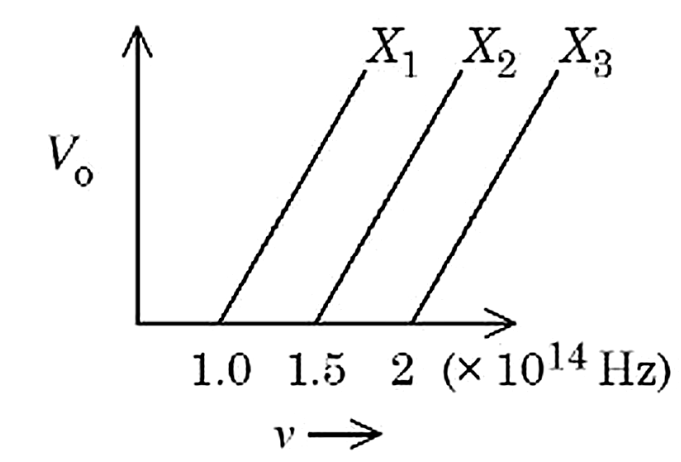
The graph shows variation of stopping potential $V_{\mathrm{o}}$ with the frequency $v$ of
the incident radiation for three photosensitive metals $X_{1},X_{2}$ and $X_{3}$.
Which metal will give out electrons with greater kinetic energy, for the
same wavelength of incident radiation?
- A.$X_{1}$
- B.$X_{2}$
- C.$X_{3}$
- D.All the metals will give out photo electrons with same kinetic energies.
Show answer & solution
Correct answer: A – $X_{1}$
SolutionStep 1: From Einstein's photoelectric equation, the maximum kinetic energy of emitted photoelectrons is:
$$K_{\max} = \frac{hc}{\lambda} - \phi_0 = \frac{hc}{\lambda} - h\nu_0$$
where $\nu_0$ is the threshold frequency (the $x$-intercept on the $V_0$ vs $\nu$ graph).
Step 2: For the same incident wavelength $\lambda$, the metal with the lowest threshold frequency $\nu_0$ will have the smallest work function $\phi_0$ and therefore emit photoelectrons with the greatest kinetic energy.
Step 3: From the graph, the threshold frequencies satisfy $\nu_{01} < \nu_{02} < \nu_{03}$ (at $1.0, 1.5, 2.0 \times 10^{14}\text{ Hz}$). Metal $X_1$ has the lowest threshold frequency.
Hence, Option (1) is correct.
Question 15
The time taken by a block of mass $m$ to slide down from the highest point to the lowest point on a rough inclined plane is $50\%$ more compared to the time taken by the same block on identical inclined smooth plane. Both inclined planes are at $45^{\circ}$ with the horizontal. The coefficient of kinetic friction between the rough inclined surface and block is ____
- A.
3/4
- B.
2/3
- C.
5/9
- D.
4/9
Show answer & solution
Correct answer: C – 5/9
SolutionStep 1: For a smooth incline of angle $\theta = 45^\circ$ and length $L$, acceleration is $a_1 = g\sin\theta$, so:
$$L = \frac{1}{2} (g\sin\theta) t_1^2$$
Step 2: For the rough incline of identical length $L$ and angle $\theta = 45^\circ$, acceleration is $a_2 = g(\sin\theta - \mu_k \cos\theta)$, so:
$$L = \frac{1}{2} g(\sin\theta - \mu_k \cos\theta) t_2^2$$
Step 3: Given $t_2 = t_1 + 0.50 t_1 = 1.5 t_1 = \frac{3}{2} t_1$. Equating the two expressions for $L$:
$$\sin\theta \cdot t_1^2 = (\sin\theta - \mu_k \cos\theta) \left(\frac{3}{2} t_1\right)^2$$
Step 4: Since $\theta = 45^\circ$, $\sin 45^\circ = \cos 45^\circ$, which cancels out:
$$1 = (1 - \mu_k) \frac{9}{4} \implies 1 - \mu_k = \frac{4}{9} \implies \mu_k = 1 - \frac{4}{9} = \frac{5}{9}$$
Hence, Option (3) is correct.